The headline message
PMS must be structured, proactive, and lifecycle-long
MDCG 2025-10 reiterates a core MDR/IVDR principle: PMS isn’t a passive complaint-handling activity—it’s a continuous, structured, and proactive system that runs throughout the device lifetime, from first placing on the market/putting into service to the end of the intended lifetime of the last device placed on the market. It is also emphasised that planning for post-market surveillance should already begin during the device development phase, in order to determine which activities will be carried out to systematically collect information on the device’s performance once it is placed on the market.
Two implications jump out:
- “Proactive” is not optional language. The guidance explicitly frames proactive PMS as deliberately seeking information beyond what arrives via complaints, e.g., literature screening, user feedback, registers/registries (where suitable), client surveys, PMCF/PMPF, etc.
- PMS outputs must drive decisions. Conclusions and any subsequent actions need to be documented via the PMS report or PSUR, and the next PMS cycle may require a revised PMS plan based on what you learned.
What’s most useful in MDCG 2025-10
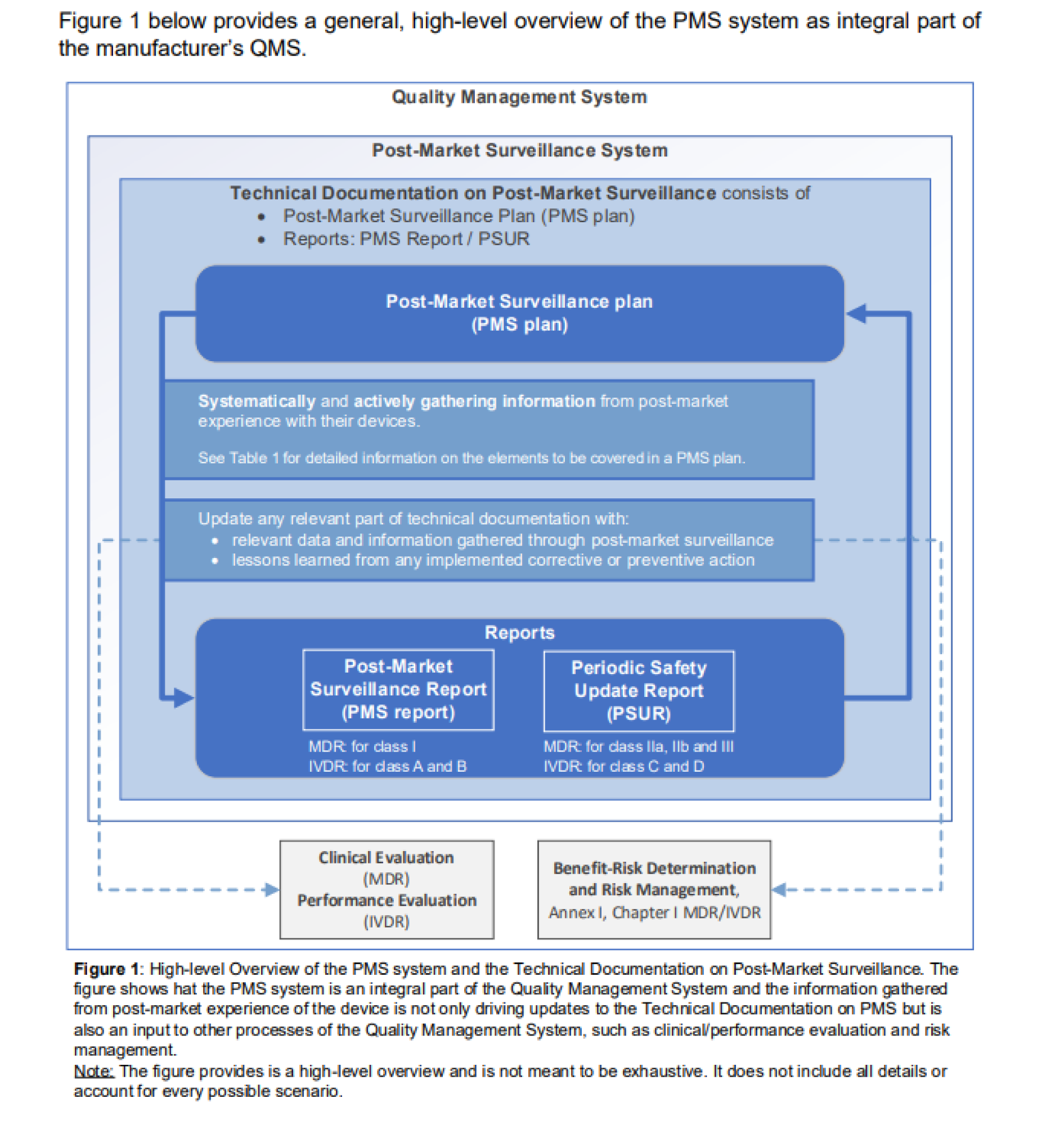
a “PMS operating model” you can map to your QMS
The guidance lays out PMS as a practical cycle:
Sources → Collection → Assessment/Analysis → Conclusions → Actions → Updates to QMS + Technical Documentation
This isn’t just conceptual. The document stresses that PMS information is used continuously to update key QMS elements, for example and especially risk management and benefit-risk and clinical/performance evaluation.
In other words: you can expect questions like “Show me where your PMS signals trigger updates to the Risk Management File, Clinical Evaluation Report labeling/IFU, and CAPA decisions.”
“Proactive data collection” gets sharpened
(and that raises the bar on your PMS plan)
MDCG 2025-10 puts real weight on the PMS plan being the engine of the system. It reinforces that the plan should define what you will monitor, how often, and which methods you will use, selected based on risk class, device type, and real-world use context. Table 1 is particularly helpful, as it provides a concise summary of the elements that must be covered in the PMS plan as set out in Section 1 of Annex III.
A few plan elements auditors may probe:
- Defined indicators + thresholds for continuous reassessment of benefit-risk and risk management (not just “we trend complaints”).
- Trend-reporting readiness: methods/protocols to detect statistically significant increases in frequency/severity of incidents subject to trend reporting and the observation period used.
- Complaint investigation approach: effective tools/methods proportionate to device risk (especially for higher-risk portfolios).
- Comparable/“similar products” intelligence as a supported input, linked to state-of-the-art (SOTA) monitoring, not as informal market gossip, but as a documented, systematic activity.
One subtle but important point: the guidance suggests the PMS plan can define “what methods,” while detailed “how/by whom” can sit in referenced SOPs, so long as the plan stays specific and traceable.
Data quality matters:
the guidance explicitly warns about weak sources
A surprisingly practical call-out: the guidance warns that unverifiable data (it even mentions public/social media as an example) can lead to overreaction, and reminds manufacturers to consider data quality and integrity before analysis.
This doesn’t mean you should ignore “noisy” channels—but it does mean you should document:
- how you triage such inputs,
- how you corroborate them (or decide not to),
- and how you prevent them from distorting trending or CAPA initiation.
Custom-made devices:
PMS expectations are explicitly reinforced (and practical)
MDCG 2025-10 includes a dedicated section clarifying that custom-made devices (CMDs) are not exempt from MDR PMS expectations. It emphasizes that manufacturers still need a PMS system and should plan/document post-production experience, including PMCF, and use groupings (same intended purpose/materials/processes/design principles) rather than treating each individual CMD as a separate full lifecycle file.
It also restates that CMD manufacturers must produce:
- PMS report for Class I CMDs, and
- PSUR for Class IIa/IIb/III CMDs,
and keep those within the CMD documentation expectations.
The “so what” for manufacturers: where to focus first
If you want fast, defensible alignment to MDCG 2025-10, these are the highest-return actions:
1) Stress-test your PMS plan against Annex III expectations
Check that your PMS plan clearly covers:
- your proactive information sources,
- methods of analysis,
- indicators/thresholds,
- complaint investigation methods,
- trending/trend reporting method + observation period,
- communication protocols (CA/NB/economic operators/users),
- and traceability tools for corrective action scope.
2) Prove the feedback loop into risk management and evaluation
The guidance is blunt: PMS findings should continuously feed into benefit-risk & RM, and into clinical/performance evaluation—and if PMS identifies new side effects or deficiencies, RM processes must follow.
A practical way to evidence this is to maintain a simple “signal-to-update” trace:
- PMS signal → assessment record → decision (no action / CAPA / FSCA / labeling change / CER update) → updated doc reference.
3) Make “conclusions + actions” visible in your PMS report/PSUR
The document highlights that conclusions and subsequent actions must be documented in the PMS report or PSUR, and that the PMS plan may need revision based on the cycle outcome.
Auditors love to see that loop closed.
What this is not:
new law, but it will shape expectations
MDCG guidance isn’t legally binding in the same way as the regulations (and the document itself includes the standard disclaimer), but it strongly influences how competent authorities and notified bodies interpret “what good looks like.”
So even if you already “do PMS,” the question becomes: does your PMS system look like the proactive, risk-based, QMS-integrated model MDCG 2025-10 describes?