
The most important facts about the revision of ISO 45001 at a glance
ISO 45001 is currently being revised. The new version of the standard is expected to be published in 2027; a transition period of three years is considered likely. The aim of the revision is to take greater account of current developments in the world of work in occupational health and safety management and to further improve the effectiveness of occupational health and safety management systems.
According to the current draft, the focus is particularly on mental health, psychosocial risks, hybrid forms of work, climate-related risks, organizational resilience and supply chain responsibility. At the same time, there are many indications that the basic structure of the standard (high-level structure) will be retained and existing requirements will be developed further in a targeted manner.
For companies, this means more integration, less bureaucracy and a stronger focus on effective prevention and a practiced safety culture.
What is the current status of the ISO 45001 revision?
The revision of ISO 45001 is currently in the "enquiry phase" of the ISO revision process. After the revision of the standard was officially confirmed at the end of 2023, the responsible Technical Committee ISO/TC 283 published the first Committee Draft (ISO/CD 45001) in July 2025.
A revised draft version followed in January 2026, including a first draft of the informative Annex A. The comments received were then evaluated by the responsible Working Group WG 6 and converted into a Draft International Standard (DIS) in mid-April 2026. This means that the 12-week international coordination phase will begin shortly, during which national standardization organizations can comment on and evaluate the draft.
The final version of the standard is currently expected to be published in 2027. A transition period of three years is then expected to apply.
What are the changes in ISO 45001:2027?
The current draft versions already indicate several topics that could be given greater consideration in the future. Rather than a fundamental realignment of the standard, there are signs of a targeted further development of existing requirements.
Among other things, the focus is on psychosocial risks and mental health, health-promoting working conditions ("workplace wellbeing"), new forms of work such as hybrid or mobile work and dealing with climate-related risks and organizational resilience. In addition, the drafts point to greater consideration of different employee needs and more intensive involvement of external service providers and supply chains.
"Many of the topics discussed are not completely new. The decisive factor will be whether organizations integrate them systematically, effectively and auditably into their SGA management system."
Which topics are the focus of the audit?
Mental health and psychosocial risks
A central theme of the revision of ISO 45001 appears to be the greater consideration of mental health and psychosocial risks. According to the current draft, there is a greater focus on work-related stress, high workloads, psychological strain, e.g. due to bullying, and social factors in the working environment. In principle, psychosocial risks are already part of the current ISO 45001:2018, particularly in connection with the identification of hazards (section 6.1.2). However, the revision indicates that these topics could be addressed more visibly and specifically in future. This development is supported, among other things, by the ISO 45003 guideline on addressing psychosocial risks in the context of occupational health and safety management systems.
Workplace wellbeing and health-promoting working conditions
Another focus is the expansion from traditional occupational health and safety to a more comprehensive understanding of safety, health and work-related wellbeing. This is associated with a stronger focus on health-promoting working conditions.
This is less about individual health services and more about organizational conditions that can influence the physical, mental and social well-being of employees. These include, for example, work organization, management behavior, communication, work intensity or the design of work processes. According to the current draft status, the preventative nature of ISO 45001 could be emphasized more strongly and expanded to include aspects of sustainable working conditions.
New forms of work and flexible working models
New forms of work such as mobile working, working from home and hybrid working models are also apparently being given greater consideration in the revision. This is due to changing working realities and increasing digitalization and AI-supported work processes. This raises new questions regarding communication, collaboration, ergonomic working conditions and mental stress.
In future, organizations may be required to systematically assess SGA risks and stress in connection with flexible forms of work and derive suitable organizational measures. In addition to this, ISO/CD 45008 has already been developed as a guideline for safe and healthy working from home and in hybrid working environments.
Safety culture and participation
The current drafts also indicate that safety culture and employee participation could become more of a focus in the future. The focus seems to be less on formal documentation and more on the actual effectiveness of the management system. Topics such as open communication, management responsibility, employee participation, learning processes and dealing with errors and near misses are becoming increasingly important in this context. The aim should be a more preventative safety culture that sees safety and health as an integral part of organizational processes.
Diversity and individual needs
According to the current draft status, the revision could also take greater account of the different requirements and needs of employees. For example, age, language skills, cultural differences, disabilities or different health requirements are mentioned in this context. Different life situations and individual burdens could also be given greater consideration in future. This makes it clear that occupational safety and health are increasingly being considered in the context of diverse and heterogeneous working environments.
Climate-related SGA risks and resilience
- ESG integration: connectivity to sustainability reporting
Climate-related risks and organizational resilience are emerging as a further area of focus. One of the reasons for this is the greater consideration of climate issues within the ISO management system standards as a result of the "ISO London Declaration on Climate Change". Supplementary requirements were already included in various management system standards in 2024, including ISO 45001.
According to the current draft status of the revision, climate-related effects on occupational health and safety in particular are moving more into focus. These include, for example
- Heat stress
- Extreme weather events
- Effects on working conditions and infrastructure
- climate-related emergency situations
- New hazards as a result of adaptation and decarbonization measures
This is associated with a stronger focus on resilience and preparedness. In future, organizations may be required to systematically incorporate climate-related risks into their risk assessment, emergency preparedness and operational planning processes. This includes, for example, adapting working hours and protective measures in the event of extreme weather events.

Do you have questions about the ISO 45001 revision?
We are here for you!
Where changes take place, questions arise.
We look forward to clarifying these together with you. We will be happy to provide you with further information on request, particularly on topics such as transfer audits or matrix certification.
Find out more. Without obligation and free of charge.
This is associated with a stronger focus on resilience and prevention. In future, organizations may be required to systematically incorporate climate-related risks into their risk assessment, emergency preparedness and operational planning processes. This includes, for example, adapting working hours and protective measures in the event of extreme weather events.
ISO/PAS 45007 "Occupational health and safety management - Risks arising from climate change and climate change action", published in January 2026, also plays an important role here. The guideline supports organizations in systematically identifying and assessing climate-related occupational health and safety risks and integrating them into existing management systems.
Supply chain responsibility - extended scope to include external partners
In addition, current developments point to a greater focus on external service providers, contractors and outsourced processes. The SGA standard already requires the management of external companies and externally provided processes. The revision could further specify this aspect, particularly against the backdrop of complex supply and value chains. For organizations, the effective management of interfaces, communication channels and responsibilities along the supply chain will become even more important.
Which adjustments are particularly relevant?
The following are particularly relevant for companies:
- New terms and definitions, e.g. "psychological risk" and "resilience"
- Greater involvement of management in the prevention culture
- More focus on results instead of documentation
- Greater focus on the working environment, including remote and supply chain risks
- Clearer interfaces with ISO 9001, ISO 14001 and ESG frameworks
This brings occupational health and safety more into the strategic management of the company.
What opportunities does the ISO 45001 revision offer?
The new ISO 45001:2027 offers more than just additional requirements: It supports an integrated view of key future issues such as occupational health and safety, health protection, sustainability and resilience. Organizations that react early not only strengthen their compliance, but also their attractiveness as an employer and their resilience to crises.
Aligning occupational health and safety management with the new standard requirements at an early stage makes it easier to obtain ISO 45001 certification later on or to transition an existing certification to the new version of the standard.
ISO 45001 revision: What organizations should do now
Actively follow the developments of the standard and check at an early stage what impact the planned changes could have on your own SGA management system.
It can also be helpful to evaluate existing emergency and precautionary processes with regard to climate-related risks, organizational resilience and changed working conditions. There could also be a greater focus on managing external service providers and outsourced processes in the future. In addition, top management should be involved in the changes at an early stage. Those who follow developments closely will be able to manage the transition to the new ISO 45001:2027 in a structured manner and without time pressure.
Many of the topics discussed are already part of effective occupational health and safety management systems. However, the revision indicates that these aspects could be specified in more detail in future and examined more intensively as part of audits.
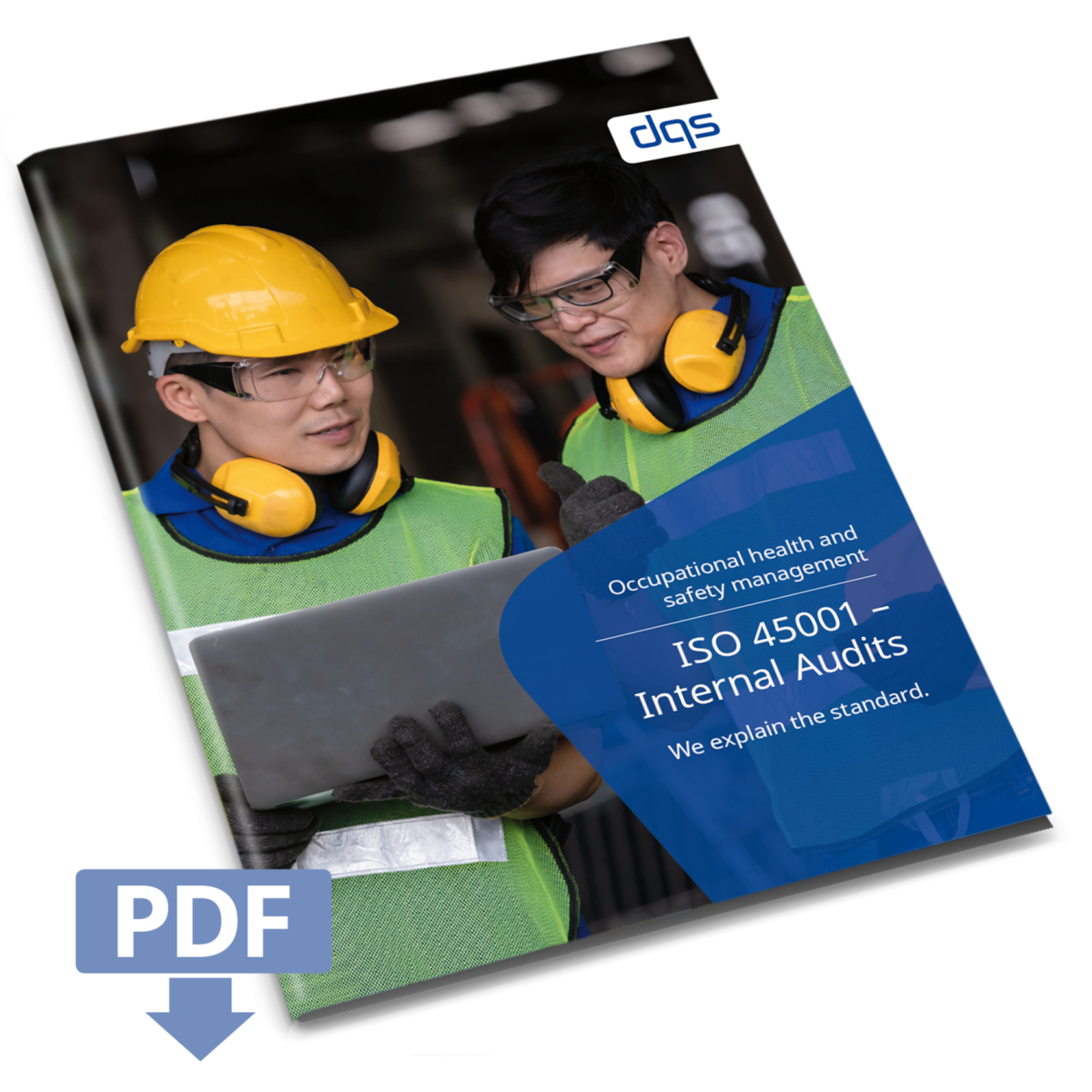
ISO 45001 - Internal audit
We interpret the standard.
Internal audits are an indispensable element of management system standards and serve as a tool for effective self-assessment. Read our free white paper to find out exactly what the SGA standard requires with regard to internal audits, the audit program and management assessment.
The role of internal audits in the auditing process
Internal audits play a central role in preparing for the new requirements. They make it possible to identify the need for action at an early stage and show how sustainable and effective the existing processes already are. In particular, organizations with complex work structures, a high proportion of mobile work or increased psychosocial stress can benefit from an early classification.
In the context of ISO 45001 audits, internal audits are also becoming increasingly important: they help organizations to realistically assess the maturity level of their prevention culture, to specifically review new topics such as mental health or supply chain risks and to actively involve management. Companies that use their internal audits strategically create the best conditions for a smooth transition to ISO 45001:2027 - and at the same time increase the effectiveness of their entire management system.
Is there any further information on ISO 45001?
DQS has been offering a wide range of information on the occupational health and safety standard for years.
White papers - topics that are worthwhile





Why is DQS your first port of call for information on the revision of ISO 45001?
Founded in 1985 as the first certification body for management systems in Germany, DQS has decades of experience and is closely networked with standardization bodies, professional circles and auditing practice. As a result, we are not only able to classify the revision of ISO 45001 in a technically sound manner. DQS sees itself as a supportive partner for both existing and new customers in the implementation and certification of the new standard. We support companies in a practical and implementation-oriented manner with regard to certification cycles and transition periods as well as topics such as transfer audits or matrix certification.
What is the timetable for the ISO 45001 revision?
As with other management system standards, the revision of ISO 45001 follows a clearly structured ISO process that goes through several draft stages - from the Committee Draft (CD) to the Draft International Standard (DIS) to the Final Draft (FDIS). This ensures that the content of ISO 45001 is harmonized, that there is international consensus and that it is developed in a practical manner. The revision process is being coordinated by the responsible ISO committee SO/TC 283 – Occupational health and safety management.
The new version of the standard is expected in 2027.
What are the phases in the revision of an ISO management system standard?
The revision of an ISO management system standard follows a multi-stage, internationally coordinated process with several rounds of drafting, commenting and voting until publication as a binding International Standard. The process takes several years, as a formal consensus procedure is followed, translations are made into numerous languages and the standard must be applicable in practice across industries and sizes worldwide.
What happens in the individual phases?
- Working Draft (WD): First working draft within the committee, serves as a rough guide.
- Committee Draft (CD): First version, which is commented on and discussed internally within ISO.
- Draft International Standard (DIS): Mature draft that can also be commented on publicly for the first time – broad participation is possible here.
- Final Draft International Standard (FDIS): Almost final version, in which only editorial changes are still possible.
- International Standard (IS): Official publication by ISO – basis for certification.
What role do other ISO guidelines play?
In connection with the revision of ISO 45001, supplementary ISO guides and sector-specific guidance documents are becoming increasingly important. They provide organizations with guidance on the practical implementation of individual topics and address current developments that have so far only been dealt with in general terms in the existing standard.
Guidance documents on psychosocial risks, hybrid forms of work and climate-related effects on occupational safety and health are particularly relevant. These include, among others:
- DIN ISO 45002:2024 – General guidelines for the implementation of ISO 45001:2018
- ISO 45003:2021 – Psychological health and safety at work – Guidelines for managing psychosocial risks
- ISO 45006:2023 – Guidelines for organizations on preventing, controlling and managing infectious diseases
- ISO/PAS 45007:2026 – Risks arising from climate change and climate change action - Guidance for organizations
- ISO/DIS 45008:2026 – Guidelines for remote working
Although these standards are not certification standards in their own right, they provide indications of which topics are becoming increasingly important in the context of the revision of ISO 45001. At the same time, they support organizations in integrating new requirements and developments into existing management systems at an early stage. The standards are available from DIN Media.
Do you have questions about the revision of ISO 45001?
We are here for you!
Where changes take place, questions arise.
We look forward to clarifying these together with you. We will be happy to provide you with further information on request, particularly on topics such as transfer audits or matrix certification.
Find out more. Without obligation and free of charge.
Revision of ISO 45001 – at a glance
The upcoming update of ISO 45001 marks an important turning point in the management system for safety and health at work. As things stand, the new version of the standard is characterized less by fundamental structural changes than by a further development of the content of existing requirements. The focus is particularly on psychosocial factors, health-promoting working conditions, new forms of work, safety culture and dealing with climate-related risks and organizational resilience.
At the same time, it underlines how requirements and expectations of a modern management system will change: Issues such as employee participation, preventative safety culture and the consideration of different work realities could become more prominent in the future.
Even if changes are still possible until the final version of the standard is published, organizations can make good use of the current phase to address foreseeable developments at an early stage and reflect on existing processes accordingly.
The upcoming requirements - from mental health to digitalization and the supply chain - will make the SGA management system fit for the challenges of the modern working world. Even if changes are still possible until the final version of the standard is published, organizations can make good use of the current phase to address the foreseeable developments at an early stage. Put processes to the test at an early stage, involve managers in the revision and focus on integration rather than bureaucracy: for more occupational safety, better health protection, more attractive working conditions and sustainable corporate development.
Questions and answers about the ISO 45001 revision
The International Organization for Standardization (ISO) regularly reviews all standards to ensure they remain aligned with social, technological, and regulatory developments. The ISO 45001 revision is intended to ensure that the international standard continues to serve as a practical management system for occupational health and safety (OHS) and does not merely meet formal requirements.
The revised ISO 45001 standard is currently expected to be published in 2027. The revision is currently in the “enquiry phase,” during which the draft is being coordinated internationally. The next milestone is the publication of the Draft International Standard.
ISO standards are regularly reviewed to ensure they remain up-to-date and relevant on an international scale. At the same time, the world of work is changing rapidly, driven by factors such as hybrid work arrangements, digitalization, AI-supported processes, and increasing demands for managing climate risks. The revision is intended to ensure that ISO 45001 takes these developments into account more effectively in the future and further improves the effectiveness of occupational health and safety management.
The international ISO committee ISO/TC 283 – Occupational Health and Safety Management – is responsible for the revision of ISO 45001. The actual revision of the standard is being carried out by Working Group WG 6, Revision of ISO 45001.
According to the current draft, the focus is particularly on psychosocial risks, mental health, hybrid work arrangements, organizational resilience, climate-related risks, and the greater integration of external service providers and supply chains.
At present, there are many indications that the basic structure of the standard will remain unchanged. The primary focus is on further developing and clarifying existing requirements, as well as placing greater emphasis on effectiveness and prevention.
As is customary with ISO management system standards, a three-year transition period is expected to apply following the publication of the new ISO 45001. During this period, existing certifications must be updated to comply with the new version of the standard.
Internal audits are becoming increasingly important in the audit process. They help organizations identify areas requiring action at an early stage, evaluate new issues, and realistically assess the effectiveness of existing processes.
Trust and expertise
Our texts and brochures are written exclusively by our standards experts or long-standing auditors. If you have any questions about the text content or our services to our author, please send us an e-mail: [email protected]
Note: For reasons of better readability, we use the generic masculine. However, the directive includes persons of all gender identities where this is necessary for the statement.