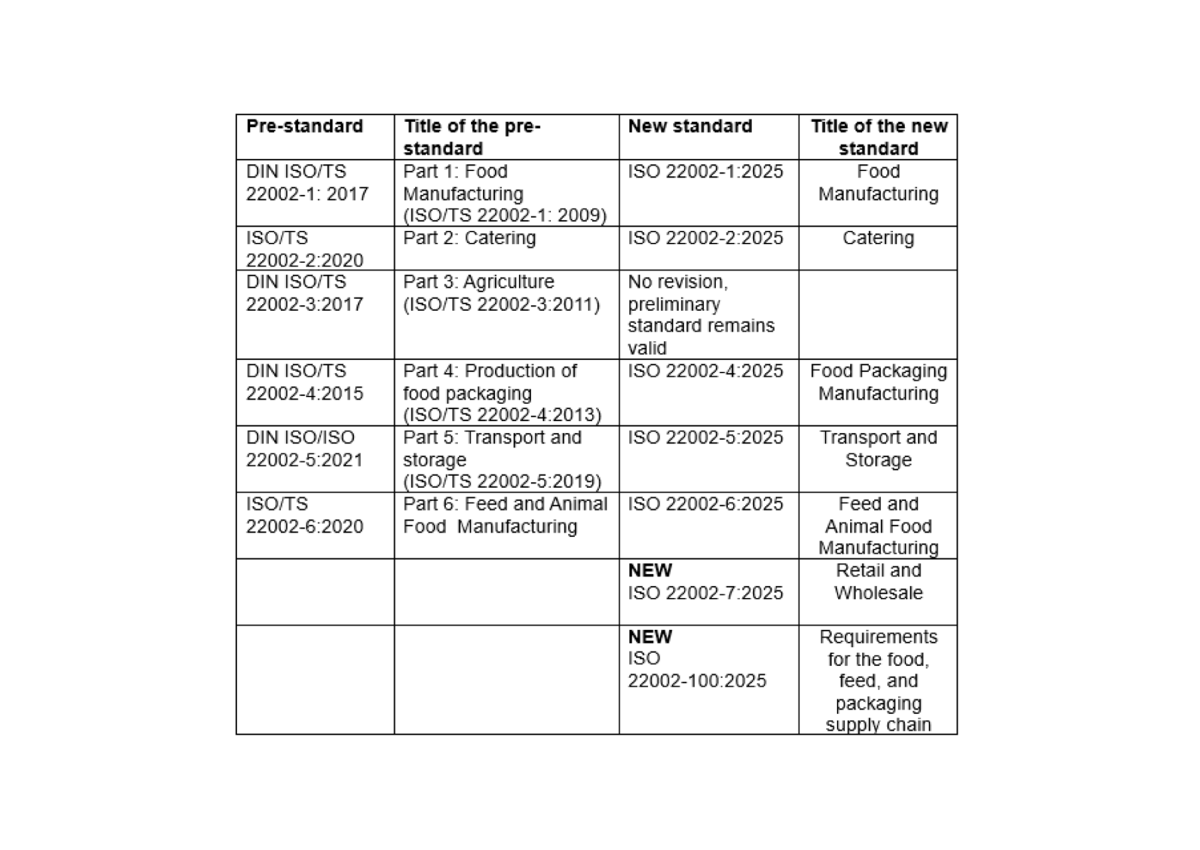
In July 2025, the ISO 22002 series of standards was revised and published. It replaces the pre-standards of the ISO/TS 22002 series. In addition, a new framework standard, ISO 22002-100, was introduced that sets out common requirements for establishing and maintaining prerequisite programs (PRPs) in the food, feed, and packaging supply chain. This revision improves the PRPs in terms of clarity, structure, and practicality and will be relevant for companies working with ISO 22000 or FSSC 22000 (Food Safety System Certification 22000).
What will change for companies working with ISO 22000 or FSSC 22000?
The International Accreditation Forum (IAF) and the International Organization for Standardization (ISO) have not yet publish the transition requirements and the timeline for the updated standards.
At present, no changes are required for FSSC 22000-certified companies, as FSSC 22000, version 6, continues to use the existing ISO/TS 22002 series, as defined in the scheme, Part 1, Section 3, Table 1 (Overview of (Sub)Categories) and Part 2, Section 2.4 (Prerequisite Programs). There are plans to integrate the updated standards of the ISO 22002 series into FSSC 22000, version 7. FSSC 22000 will thus set its own transition period and give certification bodies and certified companies sufficient time to transition to these updated PRP standards.
The review process for ISO 22000:2018 is still in its early stages. The revised standard is expected to be published in early 2027.
ISO 2002-100:2025 supports consistent application of PRPs across sectors
The new framework standard ISO 22002-100 contains all the general requirements of the previous parts 1, 2, 4, 5, and 6 of the ISO/TS 22002 series, which are applicable to all companies within the scope of ISO 22000 — from food manufacturing and trade to packaging manufacturing. Part 3, Agriculture, has not been revised. In addition, a new sector, "Food Trade," has been added with the new standard ISO 22002-7.
In addition to the creation of the framework standard ISO 22002-100, the industry-specific standards have been updated to align with ISO 22002-100.
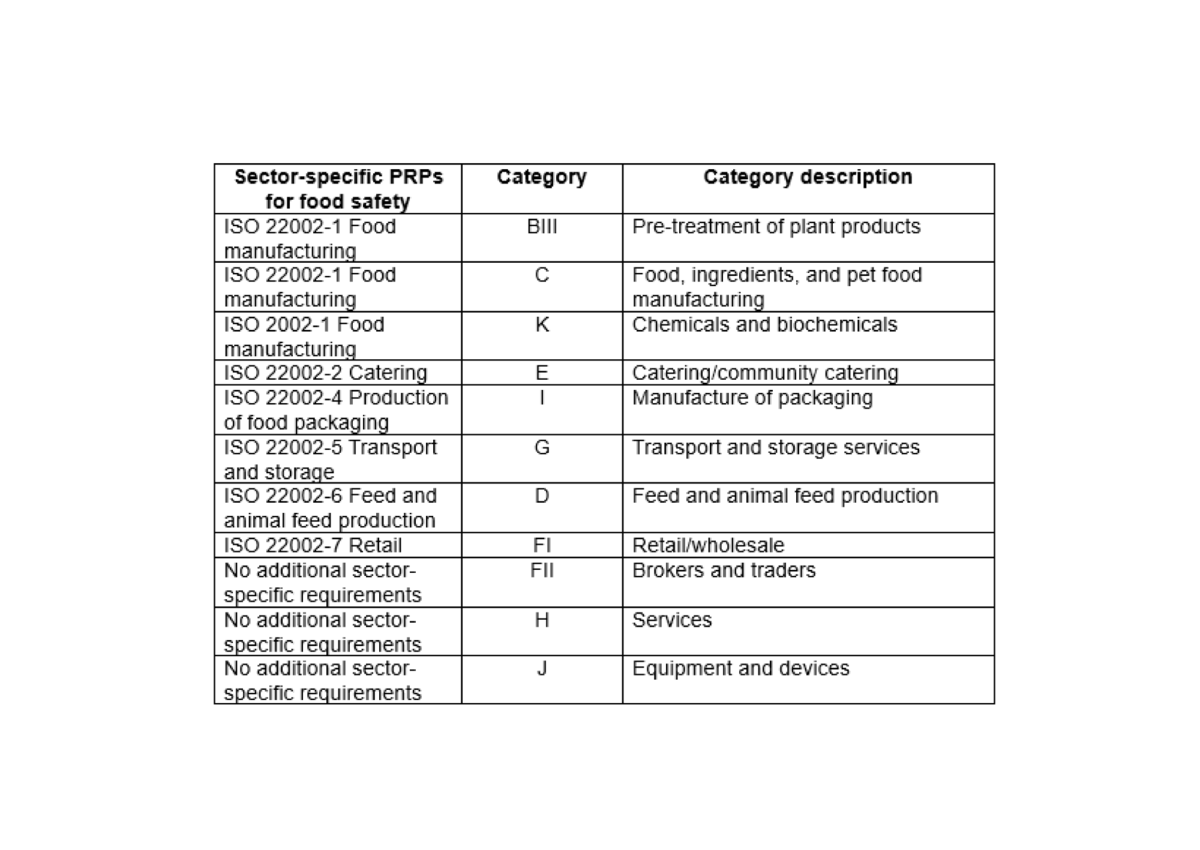
ISO 22002-100 summarizes the comparable general requirements of the sector-specific PRP standards and applies to all sectors. Thanks to this standardization, companies can operate on a consistent basis with ISO 22002-100, which is supplemented by sector-specific standards. For PRPs, the ISO 22002-100 and the corresponding part of the sector-specific standard ISO 22002-x will be applied in the future.
Comparison of PRPs for food safety:

It is advisable for companies that use this series of standards, such as ISO 22000 certified companies, to already deal with the requirements of ISO 22002-100:2025 and the corresponding relevant sector-specific standard according to the table above.
What prompted the revision of the ISO 22002 series?
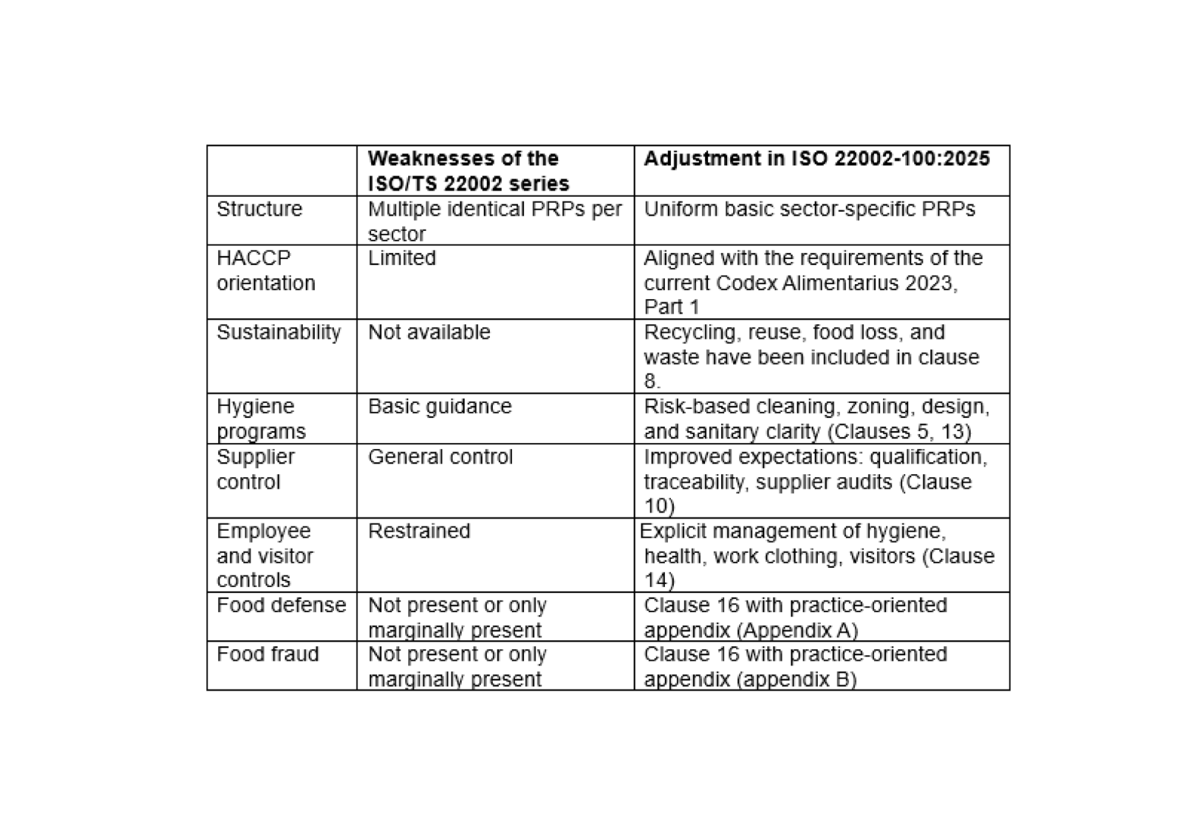
For over a decade, the ISO/TS 22002 series has formed the backbone and basis for prerequisite programs in the areas of food manufacturing, catering, food packaging production, and animal feed production. However, in recent years, the requirements for the food industry have changed significantly. This transformation has been accelerated by various circumstances, such as the emergence of new risks, changing consumer demands, globalization, and new legal requirements. In addition, the ISO/TS 22002 series has become increasingly confusing for companies with multiple categories (e.g., food and animal feed):
• Critical weaknesses and missing topics, such as food fraud, food defence, sustainability, or traceability with electronic media.
• Limited applicability across multiple sectors within a company or across global supply chains,
• Lack of alignment with new requirements, such as the Codex revision of the HACCP-based system in 2023 or modern food safety management system principles (FSMS principles).
Below are some of the weaknesses of the old ISO/TS 22002 pre-standards compared to the new ISO 22002-100:2025 standard.
Sector-specific PRPs used in conjunction with ISO 22002-100 are based on ISO 2003:2023-1, which defines the categories for food safety management systems.