
Loading...
The revision of ISO 9001 is gaining traction: with the Draft International Standard (DIS), the first complete draft is now available. The final version is expected in 2026. Although changes may still occur before publication, the draft already outlines the key areas of focus. For certified organizations, this means there is no urgent need for action – but it is a good time to familiarize yourself with the upcoming changes and consider proportionate steps such as initial gap checks.
DQS offers a unique perspective: Founded in 1985 – the same year the first drafts of the ISO 9000 family were published – we have been actively involved in representing and shaping the future of the world’s most important quality management standard from the very beginning.
On this page, you will find concise background information, the latest updates, and practical resources – including our in-depth whitepaper and an interactive readiness checklist for an initial self-assessment.
CONTENT
- Where does the ISO 9001 revision currently stand?
- What changes are on the horizon for the ISO 9001 revision?
- What should you be doing now?
- Tools and Resources
- DQS as the first point of contact for the revision of 9001
- What do industry experts expect from the ISO 9001 revision?
- ISO 9001 revision - this is the timetable
- Why the revision of ISO 9001 is important for you
- A look at important sectors
- A look back: the revision of ISO 9001:2015
- Revision of ISO 9001 - in a nutshell
- Frequently Asked Questions About the ISO 9001 Revision
Where does the ISO 9001 revision currently stand?
The first complete draft (DIS) of the new ISO 9001 was published in August 2025. For the first time, it shows specifically which topics the revision will address - such as the stronger reference to sustainability, digitalization and changing stakeholder expectations.
In most countries, the public commenting phase has now ended. The feedback is currently being compiled and reviewed, and the working group will decide on final adjustments for the final draft stage. According to the current timeline, the publication of the new ISO 9001 is expected in the second half of 2026.
We will keep you up to date with the latest developments. You can also find the latest news on developments in the committees at: https://committee.iso.org/home/tc176sc2.
What changes are on the horizon for the ISO 9001 revision?
Not every emerging trend that currently shapes our economy and society will result in a concrete requirement in ISO 9001:2026. However, some themes are already becoming more defined and are likely to be included in the revised standard. These are the areas where implementation into the revision appears most probable at this stage:
Dealing with risks and opportunities
- What’s taking shape: The distinction between risks and opportunities will likely be clarified. Until now, the risk-based approach has been formulated in a rather open way. The DIS now introduces clearer differentiation – for example, by breaking section 6.1 “Actions to address risks and opportunities” into 6.1.2 “Actions to address risks” and 6.1.3 “Actions to address opportunities”.
- Why? Many organizations struggle to identify and act on opportunities systematically. The revised standard aims to provide more clarity here – without introducing unnecessary bureaucracy.
Sustainability, ESG and climate reference
- What’s taking shape: ISO 9001 will not become an ESG standard. However, sustainability aspects in the context of the organization and its interested parties will likely be given more prominence. For example, the contents of “ISO 9001:2015 Amendment 1:2024” related to climate change have been integrated.
- Why? Quality and sustainability are becoming increasingly interconnected. Many companies already report voluntarily within ESG frameworks, and customer expectations are evolving accordingly.
Context of the organization
- What’s taking shape: The DIS introduces “strategic direction” as a new perspective, specifically in section 5.2.1 e) “Context of the organization and strategic direction”. Quality policy, objectives, and actions are expected to align more explicitly with the long-term business strategy. Artificial Intelligence (AI) could also be relevant in this context.
- Why? The addition emphasizes that context and strategy are not just background factors – they must become integral to the quality management system.
Organizational culture and leadership
- What’s taking shape: There will likely be no standalone “culture clause”, but the importance of leadership culture and value orientation will be reinforced. For example, the DIS adds a requirement in section 7.3 “Awareness”:
e) “Quality culture of the organization and ethical behavior”. - Why? It is becoming increasingly clear that management systems have limited effectiveness without a supportive culture. The standard aims to become more applicable to real-world conditions – without becoming vague.
Appendix A
The informative Annex A “Explanation of structure, terminology, and concepts” has been fundamentally revised in the DIS. It is designed to support understanding of the requirements and to provide guidance on how to interpret them – a significant update compared to the current version of the standard.
Evolution, not revolution
The 2026 revision is not a completely new standard, but a targeted evolution. Most likely, existing requirements will be clarified, supplemented, or given more context – particularly in response to insights from trend analysis.
What should you be doing now?
If you already have a management system certified to ISO 9001, the publication of the DIS is a good opportunity for a lean reality check – without actionism, but with a clear view of useful next steps. The following actions are particularly worthwhile:
- Get an overview: Briefly present the relevant DIS topics within your organization (e.g. leadership & culture, structured handling of risks and opportunities, digitalization, supply chain resilience, climate context).
- Start a quick self-assessment: Use a compact readiness checklist to determine where your organization is already well-positioned and where there may be a need for observation.
- Define priorities: Based on the self-assessment, select 2–3 focus areas to address proportionately between now and the final publication of the standard (e.g. currentness of risk and opportunity lists, transparency in software-supported processes, supplier criticality).
- Mark key dates: Use internal audits and management reviews as anchors to regularly reflect on progress and open issues.
We have prepared the following resources and tools for you:
Interactive Quick Gap Check (Self-Assessment): Our online self-assessment guides you through the key topics of the DIS (including leadership & culture, risks and opportunities, digitalization, supply chain, climate context) and provides a compact scoring overview as a starting point. Ideal for an initial, lightweight analysis. Click here for the ISO 9001 Revision Self-Assessment.
Compact transition plan: Our timeline shows at a glance what typically happens between DIS, FDIS, and final publication, and which time windows are ideal for internal reviews. It helps you plan responsibilities and evidence proportionately – without overreaction and without implementation consulting. Click here for the compact ISO 9001 transition plan.
White paper on ISO 9001:2026 (DIS): Offers clear explanations of the DIS priorities and shows how to use the quick gap check and interactive readiness checklist for initial self-assessment. Also included: practical tips for evidence-based preparation (e.g. documentation, roles, audit programs) – always from a neutral auditor perspective. Click here for the ISO 9001:2026 (DIS) white paper:
Newsletter: Compact updates on the audit schedule, new resources and event information - straight to your inbox. Subscribe to the newsletter here.
Webinars: Concise updates on the revision timeline, new resources, and upcoming events – delivered directly to your inbox.Click here for the webinar recordings.

Loading...
White Paper: ISO 9001:2026 DIS
What's changing and how to prepare
Developed by DQS's quality experts, the white paper explains what’s changing, what’s remaining consistant, and how to prepare your organization for a confident, low-disruption transition.
Why is DQS your first port of call for information on the revision of ISO 9001?
DQS and ISO 9001 have been closely connected since the beginning. DQS was founded in 1985 by DGQ ("German Association for Quality") and DIN (German Institute for Standardisation). That same year, the first drafts of the ISO 9000 family were published – marking the starting point of a shared journey. In 1986, DQS issued the first ISO 9001 certificate in Germany.
What does this mean for you? Access to insights directly from the source. To this day, our experts are active in the relevant standardization bodies. We translate discussions and drafts into clear, understandable information from an auditor’s perspective – independent, objective, and practical. This allows you to receive reliable interpretation at an early stage, helping you prepare in proportion to what the DIS indicates.
Another advantage: joint formats with strong partners. Starting in mid-2026, DGQ, DIN Media, and DQS are planning the event series “The Next Generation” – providing firsthand knowledge, delivered by leading standardization experts.
In short: With historical proximity, active involvement in standardization, and thousands of audits each year, we combine deep expertise with practical experience – delivering updates that are focused, understandable, and trustworthy.
Loading...
Blog post
The history of ISO 9001
A success story
Back in 1986, when the topic of quality management was still in its infancy, DQS issued the first ISO 9001 certificate in Germany based on the draft version. The first publication of the "ISO 9000" series of standards did not take place until 1987 as a model for quality assurance systems.
What do industry experts expect from the ISO 9001 revision?
Quality management is more than fulfilling requirements – it is an opportunity to position organizations for high performance and to create meaningful momentum in areas like sustainability, digitalization, and corporate culture.
We asked experts from the field – users and standardization professionals who are deeply connected within the industry and bring their experience into working groups and expert circles. Their insights offer a glimpse into the future viability of quality management systems.








What is the timeline for the ISO 9001 revision?
The revision of ISO 9001 follows a clearly defined process that typically spans several years. According to the current roadmap, the release of the new version is scheduled for September 2026. The most important milestones are shown at a glance in our infographic below.
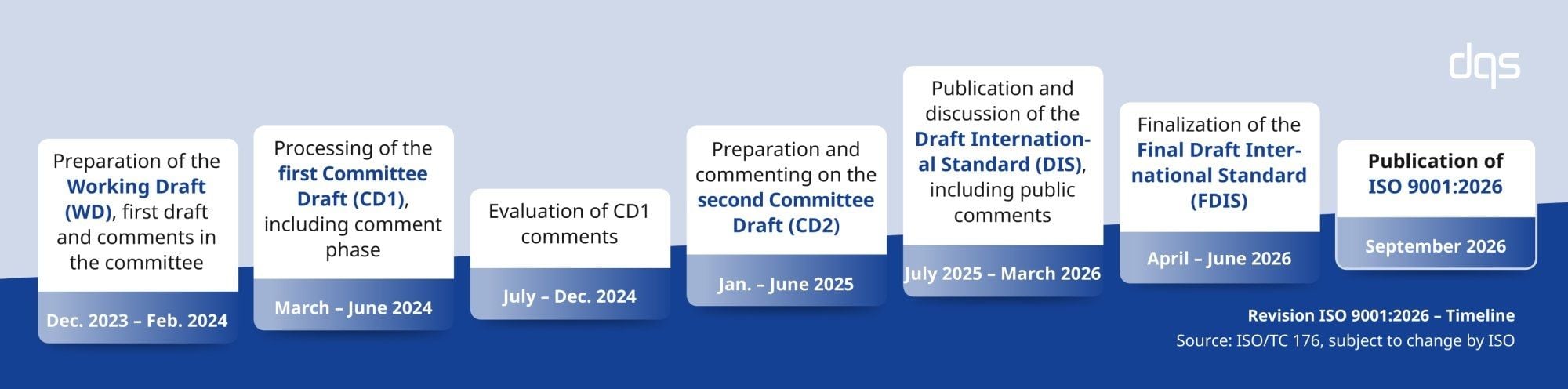
A fixed timeline helps ensure that the new ISO 9001:2026 is globally coordinated, content-wise robust, and practically applicable. All dates are to be understood as target deadlines – minor delays during the project are possible. The full revision cycle is set at 36 months and is coordinated by the international technical committee ISO/TC 176 SC2 WG29.
What happens in the individual phases?
- Working Draft (WD): Initial working draft developed within the committee, used for early orientation.
- Committee Draft (CD): First version that is commented and discussed within ISO internally.
- Draft International Standard (DIS): A mature draft that is released for the first public commenting round – broader participation is possible at this stage.
- Final Draft International Standard (FDIS): Almost final version, in which only editorial changes are still possible.
- International Standard (IS): Official publication by ISO – becomes the binding basis for certification.
Why does the revision take so long?
ISO 9001 is the world’s most widely used standard for quality management – more than one million organizations are certified. To ensure the revision meets this broad range of needs, the process must be thorough:
- Global participation: More than 160 member countries contribute their perspectives.
- Consensus process: Multiple rounds of commenting and voting ensure that all voices are heard.
- Translation: The standard must be translated into numerous languages.
- Broad applicability: It must work for start-ups as well as multinational corporations - in all sectors. The result is a standard that is recognized worldwide and works reliably in very different contexts.
Why the revision of ISO 9001 is important for you
The revision of ISO 9001 doesn't just affect quality managers – it has an impact on almost every sector, from highly regulated industries to public institutions.
The requirements of the standard are identical for all organizations. In practice, however, industry-specific priorities and implementation strategies often differ significantly. It is therefore all the more important that the revised standard is formulated in a practical manner and is compatible across all sectors.
A look at important sectors
A closer look at industry-specific expectations shows where companies see a particular need for action – especially in industries with high regulatory requirements, a strong customer focus or complex supply chains.
In the automotive industry, ISO 9001 is closely linked to the industry-specific standard IATF 16949. Changes to ISO 9001 therefore have a direct impact on the requirements along the supply chain. The industry is challenged in terms of verification, process stability and supplier management. Topics such as risk and opportunity assessment, traceability and continuous improvement are also central to the automotive industry - the revision will certainly be followed closely.
Even though ISO 9001 is traditionally very widely used in these sectors, the focus is often still on a more pragmatic application. A revision could provide impetus here - for example by anchoring a strategic understanding of quality more firmly, through a clearer understanding of opportunities and risks or through a stronger emphasis on sustainable corporate management.
For manufacturers of medical devices, but also for service providers in the healthcare sector, an effective quality management system is required by law - for example by the EU MDR or requirements of the US FDA. ISO 13485, the industry-specific standard, is based on ISO 9001. The revision therefore also has an impact here. Clarity and structure in regulatory requirements, consistent documentation and practical guidelines on quality culture and management are particularly important.
The revision of ISO 9001 is particularly important here due to its close integration with other management system standards - such as ISO 14001 for environmental management or ISO 50001 for energy management. The harmonization of the standard structure is important in order to be able to implement integrated management systems efficiently. At the same time, topics such as sustainability, ESG requirements and resilient corporate governance are coming more into focus
Service companies, especially in the IT environment, often use ISO 9001 as the structural backbone for integrated management systems - for example in combination with ISO/IEC 27001 (information security). Customer satisfaction, continuous improvement, agility and trust are key keywords. The revision is seen as an opportunity to sharpen the standard, particularly with regard to digital transformation, leadership and ethical behavior
In the education sector, ISO 9001 is particularly relevant where it is a prerequisite for public funding or accreditation. Many educational institutions have implemented QM systems that are strongly oriented towards the standard. In the revision, impulses relating to quality culture, impact measurement and customer orientation (in the sense of participant and stakeholder orientation) are seen as helpful in further developing the understanding of quality in the education sector. The revision will therefore also have an impact on the ISO 21001 management system standard specifically for the education sector
The public sector is increasingly turning to quality management in accordance with ISO 9001 - for example in administrations, public utilities or municipal service companies. However, change is taking place more slowly than in the private sector. Nevertheless, impetus is needed for more effective process design, strategic control and transparent communication. The audit offers the opportunity to establish quality management more strongly as an instrument of good governance and citizen-oriented service provision
ISO 9001 is also of central importance in the aerospace, pharmaceutical, life sciences and food industries - whether as the basis for industry-specific standards such as EN 9100, ISO 13485 or FSSC 22000. In these highly regulated sectors, the focus is on topics such as product safety, traceability, risk management and compliance. The revision is being closely monitored here, as it can provide important impetus for greater clarity, future orientation and integrated requirements
Looking Back: The ISO 9001:2015 Revision
The revision of ISO 9001 in 2015 took quality management to a new level. The so-called “major revision” was more than just a technical update – it brought about structural and content-related changes that have a profound impact on business practices.
What was new – and why?
A key objective of the revision was to better align ISO 9001 with other management system standards and adapt it to modern management and business realities. To this end, the High Level Structure (HLS) was introduced for the first time – a uniform basic structure for all ISO management system standards, with identical core requirements, terms, and structure points.
The most important new content in 2015
- Context of the organization: Companies should systematically analyze their internal and external environment – for example, market conditions, legal requirements, or social expectations. This creates more clarity about opportunities and risks.
- Interested parties: Relevant stakeholders (such as customers, authorities, employees) were explicitly taken into account. Organizations must actively observe and evaluate their requirements and expectations.
- Responsibility of top management: The role of top management was strengthened – no longer delegable, but an integral part of quality management. The goal: greater commitment and strategic alignment.
- Risk-based approach: Risk management has been systematically anchored in quality management. Preventive measures are no longer required separately, but have been incorporated into a comprehensive approach to risks and opportunities.
- Organizational knowledge: Know-how has been defined as a key resource for the first time – the aim is to identify, maintain, and develop knowledge in order to ensure the organization's performance.
In addition to these main aspects, the revision brought numerous minor clarifications and simplifications – with the aim of making the standard more user-friendly, compatible, and strategic. Many of the principles introduced at that time required a rethink and still form the basis for further development towards 2026.
In a Nutshell – 5 Key Takeaways for the ISO 9001 Revision
- Important topics are emerging: Themes like opportunity management, sustainability, strategic alignment, and culture are gaining importance. The direction of the revision is evolutionary – not revolutionary.
- No pressure to act, but a good time to start: The DIS already reveals clear tendencies. This is the right time to identify priorities and prepare with initial analyses.
- DIS published, public commenting is closed: The public review phase is complete – the focus is now on evaluating feedback and finalizing the draft.
- Timeline runs until 2026: The final standard is expected in September 2026 – giving organizations ample time to prepare proportionately.
- DQS is your trusted guide: Founded by DGQ and DIN, the first to issue an ISO 9001 certificate in Germany, and actively involved in standardization – DQS provides first-hand insights you can rely on.
Frequently Asked Questions About the ISO 9001 Revision
ISO 9001:2026 is the planned new version of the international standard for quality management systems. It will replace the currently valid version from 2015 and will continue to be based on the uniform basic structure of management system standards according to Annex SL (Harmonized Structure).
The revision aims to adapt ISO 9001 even more closely to today's operational realities and to promote the effectiveness of the management system. In terms of content, it is becoming apparent that the new version will be more precisely formulated and streamlined. At the same time, current topics – such as opportunity management, quality culture, ethical conduct, digitalization and sustainability - will be increasingly addressed.
The currently valid version of ISO 9001 dates back to 2015. Like all international standards, it is subject to a defined review cycle to ensure that it is up to date and applicable. As part of this regular review, the responsible ISO committee decided in August 2023 that a revision makes technical sense and offers added value.
As is usual with ISO standards, this multi-stage process is scheduled to take several years in order to ensure broad international participation and technical quality. The official Draft International Standard (ISO/DIS) was published by ISO in August 2025; the final version of the standard is expected in fall 2026.
An exact publication date has not yet been set. As things stand, the final publication of the revised ISO 9001 is expected in September 2026. The revision process was initiated in 2023 by the responsible ISO committee ISO/TC 176. It goes through several phases - including the preparation of drafts, an international comment phase and the final vote. The Draft International Standard (DIS) has now been published and can be obtained from DIN Media.
The final version of the new ISO 9001 will be internationally available after its publication – probably in autumn 2026 – via ISO itself(www.iso.org)
The basic structure of the standard has been retained, but individual requirements have been clarified and their content sharpened. In future, the focus will be on topics such as quality culture, ethical behavior and the resilience of supply chains. The management of risks and opportunities will become more systematic – with a clear reference to objectives, changes and performance measurement. In future, managers will be more strongly required to exemplify integrity and a sense of responsibility and promote an open working environment.
The final text of ISO 9001:2026 is not yet available. However, based on the current draft standard (ISO/DIS), it can be said that the requirements established in 2015 will be adopted. The new or clarified requirements include, for example
Chapter 4: The contents of "ISO 9001:2015 Amendment 1:2024" with reference to climate change have been integrated.
Section 5.1.1: "Promoting a culture of quality and ethical behavior"
Section 6.1: "Measures for dealing with opportunities"
Yes and no. If your current quality management system is effectively implemented and lived, no fundamental changes to your documented information are necessary. Proven aspects should be retained.
However, the revised standard introduces new content priorities and verification requirements – for example with regard to quality culture, ethical behavior and opportunity management. If your existing documents, procedures and evidence already adequately cover these topics, only minor adjustments are to be expected. Additional documentation is only required where risks or digital processes justify this (e.g. validation evidence for software).
Trust and expertise
Our texts and brochures are written exclusively by our standards experts or long-standing auditors. If you have any questions about the text content or our services to our author, we look forward to hearing from you.