
Loading...
Việc sửa đổi tiêu chuẩn ISO 9001 đang ngày càng được thúc đẩy mạnh mẽ: với bản Dự thảo Tiêu chuẩn Quốc tế (DIS), bản dự thảo hoàn chỉnh đầu tiên hiện đã được công bố. Phiên bản chính thức dự kiến sẽ được ban hành vào năm 2026. Mặc dù vẫn có thể có những thay đổi trước khi công bố, bản dự thảo này đã phác thảo những trọng tâm chính. Đối với các tổ chức đã được chứng nhận, điều này có nghĩa là chưa cần hành động gấp – nhưng đây là thời điểm phù hợp để tìm hiểu trước về các thay đổi sắp tới và cân nhắc các bước chuẩn bị phù hợp như đánh giá khoảng cách ban đầu.
DQS mang đến một góc nhìn đặc biệt: được thành lập vào năm 1985 – cùng năm mà những bản dự thảo đầu tiên của bộ tiêu chuẩn ISO 9000 được công bố – chúng tôi đã tham gia tích cực vào việc đại diện và định hình tương lai của tiêu chuẩn quản lý chất lượng quan trọng nhất thế giới ngay từ những ngày đầu.
Trên trang này, bạn sẽ tìm thấy những thông tin nền tảng ngắn gọn, các cập nhật mới nhất, và những tài nguyên thực tiễn – bao gồm Sách trắng chuyên sâu và checklist tương tác giúp bạn tự đánh giá mức độ sẵn sàng ban đầu.
CONTENT
- Where does the ISO 9001 revision currently stand?
- What changes are on the horizon for the ISO 9001 revision?
- What should you be doing now?
- Tools and Resources
- DQS as the first point of contact for the revision of 9001
- What do industry experts expect from the ISO 9001 revision?
- ISO 9001 revision - this is the timetable
- Why the revision of ISO 9001 is important for you
- A look at important sectors
- A look back: the revision of ISO 9001:2015
- Revision of ISO 9001 - in a nutshell
- Frequently Asked Questions About the ISO 9001 Revision
Where does the ISO 9001 revision currently stand?
The first complete draft (DIS) of the new ISO 9001 was published in August 2025. For the first time, it shows specifically which topics the revision will address - such as the stronger reference to sustainability, digitalization and changing stakeholder expectations.
In most countries, the public commenting phase has now ended. The feedback is currently being compiled and reviewed, and the working group will decide on final adjustments for the final draft stage. According to the current timeline, the publication of the new ISO 9001 is expected in the second half of 2026.
We will keep you up to date with the latest developments. You can also find the latest news on developments in the committees at: https://committee.iso.org/home/tc176sc2.
What changes are on the horizon for the ISO 9001 revision?
Not every emerging trend that currently shapes our economy and society will result in a concrete requirement in ISO 9001:2026. However, some themes are already becoming more defined and are likely to be included in the revised standard. These are the areas where implementation into the revision appears most probable at this stage:
Dealing with risks and opportunities
- What’s taking shape: The distinction between risks and opportunities will likely be clarified. Until now, the risk-based approach has been formulated in a rather open way. The DIS now introduces clearer differentiation – for example, by breaking section 6.1 “Actions to address risks and opportunities” into 6.1.2 “Actions to address risks” and 6.1.3 “Actions to address opportunities”.
- Why? Many organizations struggle to identify and act on opportunities systematically. The revised standard aims to provide more clarity here – without introducing unnecessary bureaucracy.
Sustainability, ESG and climate reference
- What’s taking shape: ISO 9001 will not become an ESG standard. However, sustainability aspects in the context of the organization and its interested parties will likely be given more prominence. For example, the contents of “ISO 9001:2015 Amendment 1:2024” related to climate change have been integrated.
- Why? Quality and sustainability are becoming increasingly interconnected. Many companies already report voluntarily within ESG frameworks, and customer expectations are evolving accordingly.
Context of the organization
- What’s taking shape: The DIS introduces “strategic direction” as a new perspective, specifically in section 5.2.1 e) “Context of the organization and strategic direction”. Quality policy, objectives, and actions are expected to align more explicitly with the long-term business strategy. Artificial Intelligence (AI) could also be relevant in this context.
- Why? The addition emphasizes that context and strategy are not just background factors – they must become integral to the quality management system.
Organizational culture and leadership
- What’s taking shape: There will likely be no standalone “culture clause”, but the importance of leadership culture and value orientation will be reinforced. For example, the DIS adds a requirement in section 7.3 “Awareness”:
e) “Quality culture of the organization and ethical behavior”. - Why? It is becoming increasingly clear that management systems have limited effectiveness without a supportive culture. The standard aims to become more applicable to real-world conditions – without becoming vague.
Appendix A
The informative Annex A “Explanation of structure, terminology, and concepts” has been fundamentally revised in the DIS. It is designed to support understanding of the requirements and to provide guidance on how to interpret them – a significant update compared to the current version of the standard.
Evolution, not revolution
The 2026 revision is not a completely new standard, but a targeted evolution. Most likely, existing requirements will be clarified, supplemented, or given more context – particularly in response to insights from trend analysis.
What should you be doing now?
If you already have a management system certified to ISO 9001, the publication of the DIS is a good opportunity for a lean reality check – without actionism, but with a clear view of useful next steps. The following actions are particularly worthwhile:
- Get an overview: Briefly present the relevant DIS topics within your organization (e.g. leadership & culture, structured handling of risks and opportunities, digitalization, supply chain resilience, climate context).
- Start a quick self-assessment: Use a compact readiness checklist to determine where your organization is already well-positioned and where there may be a need for observation.
- Define priorities: Based on the self-assessment, select 2–3 focus areas to address proportionately between now and the final publication of the standard (e.g. currentness of risk and opportunity lists, transparency in software-supported processes, supplier criticality).
- Mark key dates: Use internal audits and management reviews as anchors to regularly reflect on progress and open issues.
We have prepared the following resources and tools for you:
Interactive Quick Gap Check (Self-Assessment): Our online self-assessment guides you through the key topics of the DIS (including leadership & culture, risks and opportunities, digitalization, supply chain, climate context) and provides a compact scoring overview as a starting point. Ideal for an initial, lightweight analysis. Click here for the ISO 9001 Revision Self-Assessment.
Compact transition plan: Our timeline shows at a glance what typically happens between DIS, FDIS, and final publication, and which time windows are ideal for internal reviews. It helps you plan responsibilities and evidence proportionately – without overreaction and without implementation consulting. Click here for the compact ISO 9001 transition plan.
White paper on ISO 9001:2026 (DIS): Offers clear explanations of the DIS priorities and shows how to use the quick gap check and interactive readiness checklist for initial self-assessment. Also included: practical tips for evidence-based preparation (e.g. documentation, roles, audit programs) – always from a neutral auditor perspective. Click here for the ISO 9001:2026 (DIS) white paper:
Newsletter: Compact updates on the audit schedule, new resources and event information - straight to your inbox. Subscribe to the newsletter here.
Webinars: Concise updates on the revision timeline, new resources, and upcoming events – delivered directly to your inbox.Click here for the webinar recordings.

Loading...
White Paper: ISO 9001:2026 DIS
What's changing and how to prepare
Developed by DQS's quality experts, the white paper explains what’s changing, what’s remaining consistant, and how to prepare your organization for a confident, low-disruption transition.
Why is DQS your first port of call for information on the revision of ISO 9001?
DQS and ISO 9001 have been closely connected since the beginning. DQS was founded in 1985 by DGQ ("German Association for Quality") and DIN (German Institute for Standardisation). That same year, the first drafts of the ISO 9000 family were published – marking the starting point of a shared journey. In 1986, DQS issued the first ISO 9001 certificate in Germany.
What does this mean for you? Access to insights directly from the source. To this day, our experts are active in the relevant standardization bodies. We translate discussions and drafts into clear, understandable information from an auditor’s perspective – independent, objective, and practical. This allows you to receive reliable interpretation at an early stage, helping you prepare in proportion to what the DIS indicates.
Another advantage: joint formats with strong partners. Starting in mid-2026, DGQ, DIN Media, and DQS are planning the event series “The Next Generation” – providing firsthand knowledge, delivered by leading standardization experts.
In short: With historical proximity, active involvement in standardization, and thousands of audits each year, we combine deep expertise with practical experience – delivering updates that are focused, understandable, and trustworthy.
Loading...
Blog post
The history of ISO 9001
A success story
Back in 1986, when the topic of quality management was still in its infancy, DQS issued the first ISO 9001 certificate in Germany based on the draft version. The first publication of the "ISO 9000" series of standards did not take place until 1987 as a model for quality assurance systems.
What do industry experts expect from the ISO 9001 revision?
Quality management is more than fulfilling requirements – it is an opportunity to position organizations for high performance and to create meaningful momentum in areas like sustainability, digitalization, and corporate culture.
We asked experts from the field – users and standardization professionals who are deeply connected within the industry and bring their experience into working groups and expert circles. Their insights offer a glimpse into the future viability of quality management systems.








What is the timeline for the ISO 9001 revision?
The revision of ISO 9001 follows a clearly defined process that typically spans several years. According to the current roadmap, the release of the new version is scheduled for September 2026. The most important milestones are shown at a glance in our infographic below.
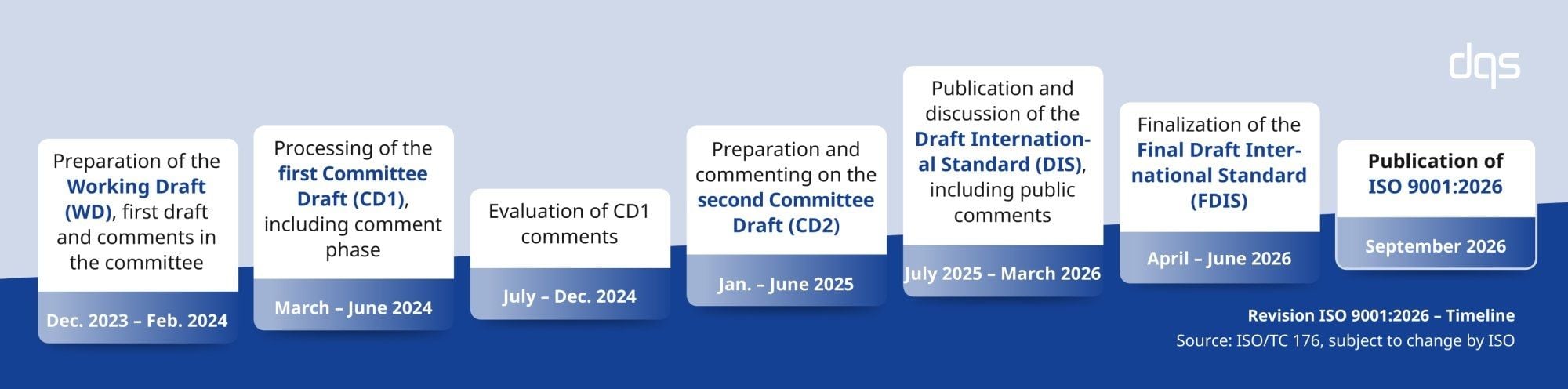
A fixed timeline helps ensure that the new ISO 9001:2026 is globally coordinated, content-wise robust, and practically applicable. All dates are to be understood as target deadlines – minor delays during the project are possible. The full revision cycle is set at 36 months and is coordinated by the international technical committee ISO/TC 176 SC2 WG29.
What happens in the individual phases?
- Working Draft (WD): Initial working draft developed within the committee, used for early orientation.
- Committee Draft (CD): First version that is commented and discussed within ISO internally.
- Draft International Standard (DIS): A mature draft that is released for the first public commenting round – broader participation is possible at this stage.
- Final Draft International Standard (FDIS): Almost final version, in which only editorial changes are still possible.
- International Standard (IS): Official publication by ISO – becomes the binding basis for certification.
Why does the revision take so long?
ISO 9001 is the world’s most widely used standard for quality management – more than one million organizations are certified. To ensure the revision meets this broad range of needs, the process must be thorough:
- Global participation: More than 160 member countries contribute their perspectives.
- Consensus process: Multiple rounds of commenting and voting ensure that all voices are heard.
- Translation: The standard must be translated into numerous languages.
- Broad applicability: It must work for start-ups as well as multinational corporations - in all sectors. The result is a standard that is recognized worldwide and works reliably in very different contexts.
Why the revision of ISO 9001 is important for you
The revision of ISO 9001 doesn't just affect quality managers – it has an impact on almost every sector, from highly regulated industries to public institutions.
The requirements of the standard are identical for all organizations. In practice, however, industry-specific priorities and implementation strategies often differ significantly. It is therefore all the more important that the revised standard is formulated in a practical manner and is compatible across all sectors.
A look at important sectors
A closer look at industry-specific expectations shows where companies see a particular need for action – especially in industries with high regulatory requirements, a strong customer focus or complex supply chains.
Trong ngành ô tô, ISO 9001 có mối liên hệ chặt chẽ với tiêu chuẩn chuyên ngành IATF 16949. Do đó, các thay đổi của ISO 9001 sẽ có tác động trực tiếp đến các yêu cầu trong toàn bộ chuỗi cung ứng.
Ngành này đang đối mặt với nhiều thách thức liên quan đến việc xác minh, tính ổn định của quy trình và quản lý nhà cung cấp. Các chủ đề như đánh giá rủi ro và cơ hội, truy xuất nguồn gốc và cải tiến liên tục cũng đóng vai trò trung tâm trong ngành ô tô – vì vậy, quá trình sửa đổi tiêu chuẩn chắc chắn sẽ được theo dõi sát sao.
Mặc dù ISO 9001 từ lâu đã được áp dụng rộng rãi trong các lĩnh vực này, nhưng trọng tâm thường vẫn thiên về cách tiếp cận mang tính thực dụng. Lần sửa đổi này có thể tạo thêm động lực – ví dụ như củng cố mạnh mẽ hơn tư duy chiến lược về chất lượng, làm rõ hơn cách hiểu về cơ hội và rủi ro, hoặc nhấn mạnh hơn vào quản trị doanh nghiệp bền vững.
Đối với các nhà sản xuất thiết bị y tế, cũng như các đơn vị cung cấp dịch vụ trong lĩnh vực chăm sóc sức khỏe, một hệ thống quản lý chất lượng hiệu quả là yêu cầu bắt buộc theo quy định pháp luật – ví dụ như Quy định MDR của EU hoặc các yêu cầu của FDA Hoa Kỳ. Tiêu chuẩn chuyên ngành ISO 13485 được xây dựng dựa trên ISO 9001, vì vậy lần sửa đổi này cũng sẽ có tác động đến lĩnh vực này.
Sự rõ ràng và cấu trúc trong các yêu cầu pháp lý, tài liệu nhất quán, cũng như các hướng dẫn thực tiễn về văn hóa chất lượng và quản lý là những yếu tố đặc biệt quan trọng.
Việc sửa đổi ISO 9001 đặc biệt quan trọng trong lĩnh vực này do sự liên kết chặt chẽ với các tiêu chuẩn hệ thống quản lý khác – như ISO 14001 về quản lý môi trường hoặc ISO 50001 về quản lý năng lượng. Việc hài hòa cấu trúc tiêu chuẩn là yếu tố then chốt để có thể triển khai hiệu quả các hệ thống quản lý tích hợp.
Đồng thời, các chủ đề như phát triển bền vững, yêu cầu ESG và quản trị doanh nghiệp có khả năng chống chịu, phục hồi cũng ngày càng được chú trọng.
Các doanh nghiệp dịch vụ, đặc biệt trong lĩnh vực CNTT, thường sử dụng ISO 9001 như nền tảng cấu trúc cho các hệ thống quản lý tích hợp – ví dụ kết hợp với ISO/IEC 27001 (an ninh thông tin). Sự hài lòng của khách hàng, cải tiến liên tục, tính linh hoạt (agility) và sự tin cậy là những yếu tố then chốt.
Lần sửa đổi này được xem là cơ hội để hoàn thiện hơn tiêu chuẩn, đặc biệt trong các khía cạnh liên quan đến chuyển đổi số, vai trò lãnh đạo và hành vi đạo đức.
Trong lĩnh vực giáo dục, ISO 9001 đặc biệt có ý nghĩa khi đây là điều kiện tiên quyết cho việc nhận tài trợ công hoặc công nhận. Nhiều cơ sở giáo dục đã triển khai hệ thống quản lý chất lượng với định hướng bám sát tiêu chuẩn này.
Trong lần sửa đổi, các yếu tố như văn hóa chất lượng, đo lường hiệu quả và định hướng khách hàng (theo nghĩa hướng tới người học và các bên liên quan) được xem là những động lực hữu ích để phát triển hơn nữa cách hiểu về chất lượng trong lĩnh vực giáo dục. Vì vậy, lần sửa đổi này cũng sẽ có tác động đến tiêu chuẩn hệ thống quản lý ISO 21001 dành riêng cho lĩnh vực giáo dục.
Khu vực công ngày càng áp dụng quản lý chất lượng theo ISO 9001 – ví dụ trong các cơ quan hành chính, đơn vị tiện ích công hoặc các doanh nghiệp dịch vụ đô thị. Tuy nhiên, quá trình thay đổi thường diễn ra chậm hơn so với khu vực tư nhân.
Dù vậy, vẫn cần những động lực để nâng cao hiệu quả thiết kế quy trình, tăng cường kiểm soát chiến lược và cải thiện tính minh bạch trong truyền thông. Hoạt động đánh giá mang lại cơ hội để củng cố vai trò của quản lý chất lượng như một công cụ hỗ trợ quản trị tốt và cung cấp dịch vụ hướng tới người dân.
ISO 9001 cũng giữ vai trò then chốt trong các lĩnh vực như hàng không vũ trụ, dược phẩm, khoa học sự sống và thực phẩm – như nền tảng cho các tiêu chuẩn chuyên ngành như EN 9100, ISO 13485 hoặc FSSC 22000.
Trong các ngành có yêu cầu quản lý nghiêm ngặt này, trọng tâm thường nằm ở các yếu tố như an toàn sản phẩm, truy xuất nguồn gốc, quản lý rủi ro và tuân thủ quy định. Vì vậy, quá trình sửa đổi đang được theo dõi sát sao, bởi nó có thể mang lại những định hướng quan trọng nhằm tăng cường tính rõ ràng, khả năng thích ứng tương lai và sự tích hợp giữa các yêu cầu.
Looking Back: The ISO 9001:2015 Revision
The revision of ISO 9001 in 2015 took quality management to a new level. The so-called “major revision” was more than just a technical update – it brought about structural and content-related changes that have a profound impact on business practices.
What was new – and why?
A key objective of the revision was to better align ISO 9001 with other management system standards and adapt it to modern management and business realities. To this end, the High Level Structure (HLS) was introduced for the first time – a uniform basic structure for all ISO management system standards, with identical core requirements, terms, and structure points.
The most important new content in 2015
- Context of the organization: Companies should systematically analyze their internal and external environment – for example, market conditions, legal requirements, or social expectations. This creates more clarity about opportunities and risks.
- Interested parties: Relevant stakeholders (such as customers, authorities, employees) were explicitly taken into account. Organizations must actively observe and evaluate their requirements and expectations.
- Responsibility of top management: The role of top management was strengthened – no longer delegable, but an integral part of quality management. The goal: greater commitment and strategic alignment.
- Risk-based approach: Risk management has been systematically anchored in quality management. Preventive measures are no longer required separately, but have been incorporated into a comprehensive approach to risks and opportunities.
- Organizational knowledge: Know-how has been defined as a key resource for the first time – the aim is to identify, maintain, and develop knowledge in order to ensure the organization's performance.
In addition to these main aspects, the revision brought numerous minor clarifications and simplifications – with the aim of making the standard more user-friendly, compatible, and strategic. Many of the principles introduced at that time required a rethink and still form the basis for further development towards 2026.
In a Nutshell – 5 Key Takeaways for the ISO 9001 Revision
- Important topics are emerging: Themes like opportunity management, sustainability, strategic alignment, and culture are gaining importance. The direction of the revision is evolutionary – not revolutionary.
- No pressure to act, but a good time to start: The DIS already reveals clear tendencies. This is the right time to identify priorities and prepare with initial analyses.
- DIS published, public commenting is closed: The public review phase is complete – the focus is now on evaluating feedback and finalizing the draft.
- Timeline runs until 2026: The final standard is expected in September 2026 – giving organizations ample time to prepare proportionately.
- DQS is your trusted guide: Founded by DGQ and DIN, the first to issue an ISO 9001 certificate in Germany, and actively involved in standardization – DQS provides first-hand insights you can rely on.
Frequently Asked Questions About the ISO 9001 Revision
ISO 9001:2026 là phiên bản dự kiến mới của tiêu chuẩn quốc tế về hệ thống quản lý chất lượng. Phiên bản này sẽ thay thế phiên bản hiện hành năm 2015 và tiếp tục dựa trên cấu trúc nền tảng thống nhất của các tiêu chuẩn hệ thống quản lý theo Phụ lục SL (Cấu trúc bậc cao).
Mục tiêu của lần sửa đổi là điều chỉnh ISO 9001 phù hợp hơn với thực tiễn vận hành hiện nay và nâng cao hiệu lực của hệ thống quản lý. Về nội dung, có thể thấy rằng phiên bản mới sẽ được xây dựng rõ ràng và tinh gọn hơn. Đồng thời, các chủ đề hiện đại như quản lý cơ hội, văn hóa chất lượng, hành vi đạo đức, chuyển đổi số và phát triển bền vững sẽ được chú trọng hơn.
Phiên bản ISO 9001 hiện hành được ban hành từ năm 2015. Giống như tất cả các tiêu chuẩn quốc tế, tiêu chuẩn này tuân theo một chu kỳ rà soát định kỳ nhằm đảm bảo luôn cập nhật và phù hợp với thực tiễn áp dụng. Trong khuôn khổ đợt rà soát này, ủy ban ISO phụ trách đã quyết định vào tháng 8 năm 2023 rằng việc sửa đổi là cần thiết về mặt kỹ thuật và mang lại giá trị gia tăng.
Cũng như thông lệ đối với các tiêu chuẩn ISO, quy trình nhiều giai đoạn này dự kiến kéo dài trong vài năm để đảm bảo sự tham gia rộng rãi trên toàn cầu và chất lượng chuyên môn. Bản Dự thảo Tiêu chuẩn Quốc tế chính thức (ISO/DIS) đã được ISO công bố vào tháng 8 năm 2025; phiên bản tiêu chuẩn cuối cùng dự kiến sẽ được ban hành vào mùa thu năm 2026.
Hiện tại, chưa có ngày công bố chính thức cụ thể. Theo tiến độ hiện nay, phiên bản ISO 9001 sửa đổi dự kiến sẽ được ban hành vào tháng 9 năm 2026. Quá trình sửa đổi đã được khởi động từ năm 2023 bởi ủy ban ISO phụ trách ISO/TC 176. Quy trình này trải qua nhiều giai đoạn – bao gồm xây dựng dự thảo, giai đoạn lấy ý kiến quốc tế và bỏ phiếu thông qua cuối cùng. Bản Dự thảo Tiêu chuẩn Quốc tế (DIS) hiện đã được công bố và có thể được cung cấp thông qua DIN Media.
Phiên bản cuối cùng của ISO 9001 mới sẽ được phát hành rộng rãi trên toàn cầu sau khi công bố – dự kiến vào mùa thu năm 2026 – thông qua chính tổ chức ISO (www.iso.org).
Cấu trúc cơ bản của tiêu chuẩn vẫn được giữ nguyên, tuy nhiên các yêu cầu riêng lẻ đã được làm rõ và được cụ thể hóa hơn về nội dung. Trong tương lai, trọng tâm sẽ tập trung vào các chủ đề như văn hóa chất lượng, hành vi đạo đức và khả năng chống chịu của chuỗi cung ứng.
Việc quản lý rủi ro và cơ hội sẽ trở nên có hệ thống hơn – với sự liên kết rõ ràng tới mục tiêu, các thay đổi và việc đo lường hiệu quả hoạt động. Đồng thời, các nhà quản lý sẽ được yêu cầu mạnh mẽ hơn trong việc thể hiện tính chính trực, tinh thần trách nhiệm và thúc đẩy một môi trường làm việc cởi mở.
Văn bản chính thức của ISO 9001:2026 hiện vẫn chưa được ban hành. Tuy nhiên, dựa trên bản dự thảo hiện tại (ISO/DIS), có thể thấy rằng các yêu cầu đã được thiết lập từ năm 2015 sẽ tiếp tục được duy trì. Một số yêu cầu mới hoặc được làm rõ bao gồm:
- Điều khoản 4: Nội dung của “ISO 9001:2015 Amendment 1:2024” liên quan đến biến đổi khí hậu đã được tích hợp.
- Điều khoản 5.1.1: “Thúc đẩy văn hóa chất lượng và hành vi đạo đức”.
- Điều khoản 6.1: “Các biện pháp xử lý cơ hội”.
Câu trả lời là có và không. Nếu hệ thống quản lý chất lượng hiện tại của bạn đang được triển khai hiệu quả và vận hành thực tế, thì không cần có những thay đổi mang tính căn bản đối với thông tin dạng văn bản. Những nội dung đã được chứng minh là hiệu quả nên tiếp tục được duy trì.
Tuy nhiên, tiêu chuẩn sửa đổi đưa ra các trọng tâm nội dung và yêu cầu chứng minh mới – ví dụ liên quan đến văn hóa chất lượng, hành vi đạo đức và quản lý cơ hội. Nếu các tài liệu, quy trình và bằng chứng hiện có của bạn đã bao quát đầy đủ những nội dung này, thì chỉ cần điều chỉnh nhỏ.
Việc bổ sung tài liệu chỉ thực sự cần thiết khi có rủi ro hoặc các quy trình số yêu cầu – ví dụ như bằng chứng xác nhận đối với phần mềm.
Trust and expertise
Our texts and brochures are written exclusively by our standards experts or long-standing auditors. If you have any questions about the text content or our services to our author, we look forward to hearing from you.