
DQS 稽核與證書相關規範
1. Audit and Certification Services
1.1 Scope and Applicability
These DQS Audit and Certification Regulations (“Regulations”) apply to all offers and/or services and all resulting contractual relationship(s) between DQS Holding GmbH, any affiliated companies or any of their agents (each “DQS”, together “DQS Group”) and any organization/person (“Client”) applying for or receiving audit and certification services.
A current list of all members of the DQS Group is available at https://dqsglobal.com/intl.
These Regulations cover all kinds of System Certification in accordance with international or national standards, including private standards, Product Certification in accordance with EU Directives or national legislation, Product and Service Certification in accordance with non-regulated normative documents, specifications, requirements or technical rules.
These regulations apply throughout all stages of the certification or audit process, including but not limited to service offers and quotations, contracts, purchase and/or work orders, schedules and addendums agreed to between DQS and Client, unless it is otherwise explicitly agreed in writing or so prescribed by statutory instruments.
These Audit and Certification Regulations become effective with immediate effect after their publication and remain valid until a new version is issued and published.
The current version of these regulations is available in English language at https://dqsglobal.com/intl/about/accreditation-and-notification/dqs-group-auditing-and-certification-rules or upon request from every DQS office. Should any discrepancy occur between a translated version and the English version of the document, the English version shall takes precedence.
Where a Certificate is issued to the Client, DQS will provide the services using reasonable care and skill and in accordance with the Codes of Practice then in force of the relevant DQS Certification Body. A copy of such Codes of Practice, and any amendments to it as may be issued from time to time, will be made available by the DQS Certification Body to the Client upon commencement of the Services.
1.2 Definition of terms
- “Client” stands for customers and any organization/person that inquires about or receives any DQS audit or certification service, including their representatives, who act on their behalf.
- “DQS” stands for any group member of the international DQS Group, including its subsidiaries, affiliated companies and partners or any of their agents, who offer and/or deliver in their own name or in behalf of another DQS Certification Body audit and certification services to Clients.
- “DQS Certification Body” means any DQS entity having the accreditation or authorization to issue the respective certificates.
- “Codes of Practice” means those codes of practice issued by a DQS Certification Body for the relevant certification program.
- “Accreditation body” means any organization (whether public or private) having the authorization to appoint and supervise Certification Bodies
- “Audits” stands for any systematic DQS activity for obtaining objective evidence and evaluating it objectively to determine the extent to which defined criteria are fulfilled; it may be also referred as “assessment”.
- “Auditors” stands for assessors, auditors and experts, who are assigned to an audit and certification process on behalf of the DQS group.
1.3 Audit and Certification Services
The auditing and certification of a management system, a process or of a product by an independent, competent third party, such as DQS, generates valuable benefits for the Client. A DQS certificate will serve as evidence for a suitable and effective management system, a process or compliant product with the capability to continuously meet customer expectations as well as regulatory and statutory requirements.
During an audit, qualified and experienced auditors review the management system and its processes or products for ongoing suitability and effectiveness in light of changing markets and environment. By identifying improvement potential, auditors enhance the organization’s ability to meet established goals and objectives, thus enhancing sustainable success for the Client. With a DQS certificate, customers may place confidence on the Client and the certified management system, process or product, which has been assessed and certified to recognized standards and specifications.
1.4 The Contract and Commercial Terms
These DQS Audit and Certification Regulations, and, as applicable, the application, the quotation, its acceptance, the Codes of Practice, the conditions of DQS Certification Marks and local business conditions or commercial terms constitute the entire agreement (the “Contract”) between the Client and DQS with respect to the subject matter hereof.
Local business conditions or commercial terms may include clauses on legal representation, jurisdiction, liability, tax, terms of payment and others, considering local legal requirements. The contract may be also constituted by individual agreements between DQS and the Client, containing always these DQS Audit and Certification Regulations as an integral part of it through direct inclusion or reference.
Save as otherwise provided no variation to the contract shall be valid unless it is in writing.
1.5 Contractual relationship to the DQS Certification Body
Whenever a DQS office provides a service under authorization or accreditation of another DQS Certification Body, it acts as an agent in name and in behalf on that entity. The offer/quotation identifies the respective DQS Certification Body and its acceptance and signature of the local contract constitutes a legally binding certification contract between Client and the DQS Certification Body. Although the agent is authorized to charge/invoice the Client for the service provision and certification, the responsibility for the certification activities and the operational control under a specific accreditation remains always with the DQS Certification Body which is responsible for, and retains authority for, its decisions relating to certification, including the granting, refusing, maintaining of certification, expanding or reducing the scope of certification, renewing, suspending or restoring following suspension, or withdrawing of certification.
2. The Certification Process
DQS assesses the Client’s management system, processes, products or parts thereof, with the goal of determining its conformity with agreed and acknowledged requirements, such as international, national or sector-specific standards or specifications. The respective certification process may involve one or more steps, usually ending with an audit report, which documents the audit results. In the case of certification services, the respective DQS Certification Body will issue a customer-specific certificate, confirming conformity to the respective requirements, when the fulfillment of all applicable requirements has been evident.
If nonconformities with requirements of the respective standard or specification have been identified during an audit, corrective action shall be planned and carried out by Client within a specified time frame. Certificates will only be issued after the effective deployment of suitable corrective action has been demonstrated. The scope and duration of validity shall be stated on the certificate.
Most audit findings are based on a sampling process, targeted towards reliable evidence for effective implementation and compliance of the management system, process or product. Further business aspects may exist, positive or negative, which have not been reviewed by the audit team. It is the sole organization´s responsibility to investigate and evaluate the potential impact and scope of findings, thus continuously ensuring full compliance to the applied standard(s). In cases of non-compliance, DQS is not liable.
DQS is independent, neutral and objective in its audits and certifications. Audits are normally performed at Client’s place of operations (on-site) but may be partially conducted, substituted or complemented by remote auditing activities (off-site). The type, extent and time schedule of the procedure are subject to separate agreement by the parties. DQS strives to minimize any disturbances of the business process while conducting the audit on Client’s premises.
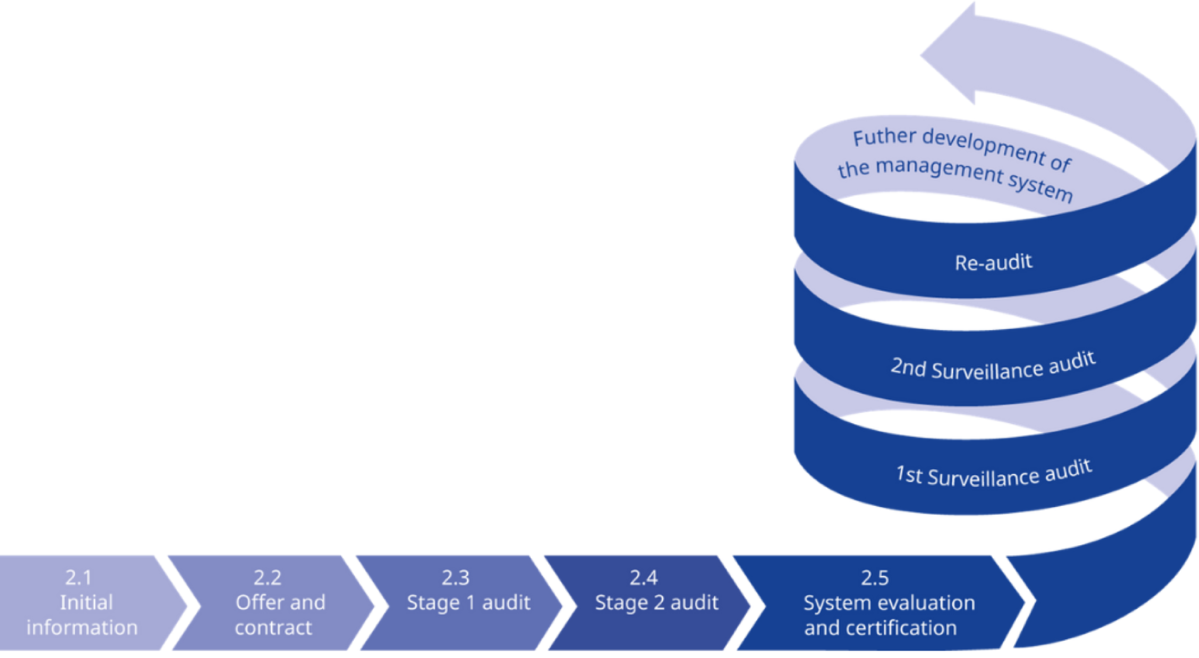
DQS Certification process for management systems
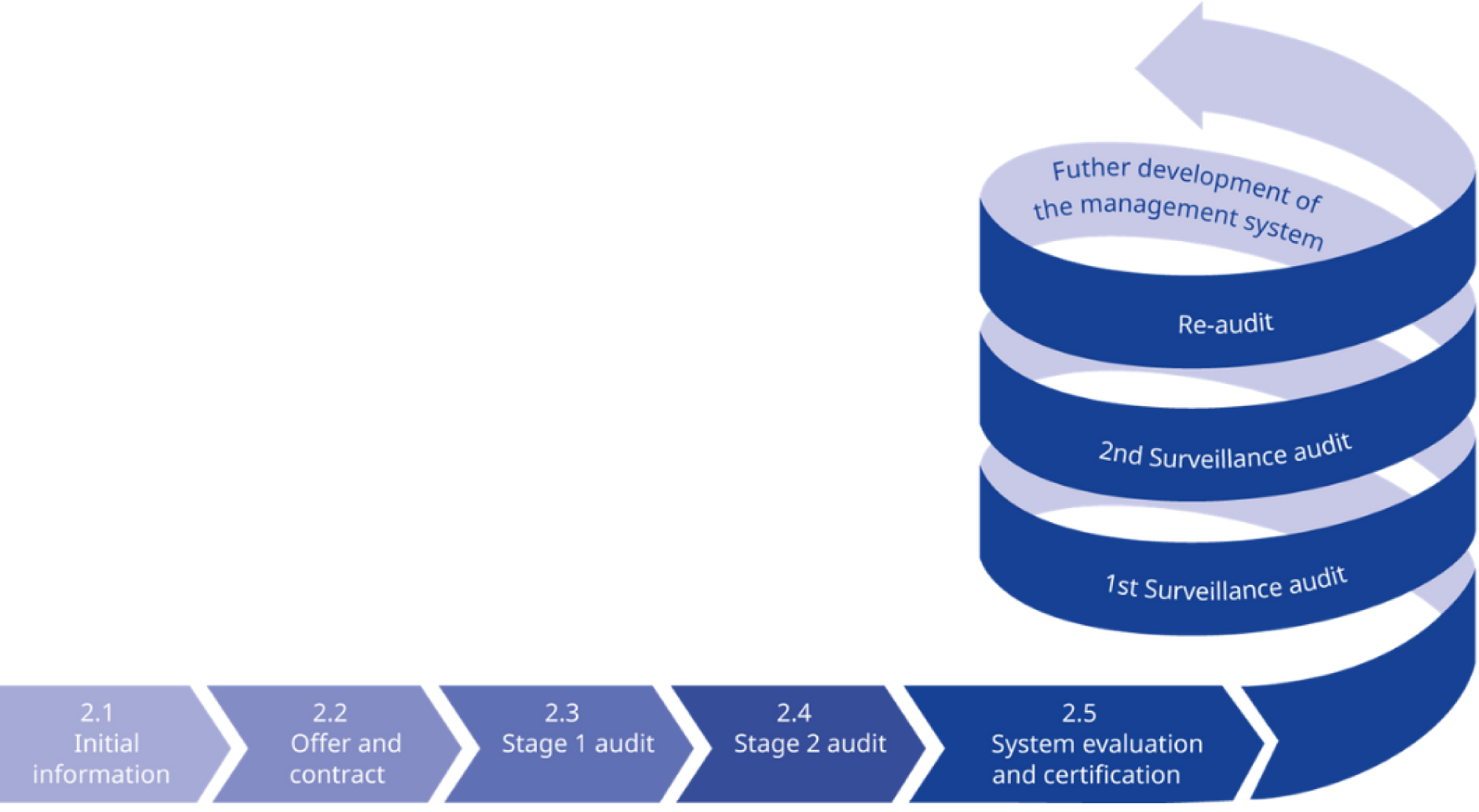
2.1 The process begins with the client’s needs and expectations. DQS wants to learn about the client’s organization and its management system, size and types of operation. Both parties jointly define the objectives of the audits and/or certification, including the applicable standards and specifications.
2.2 Based on the necessary information, DQS conducts an application review and subsequently prepares a detailed offer for the assessment/audit and certification, tailored to the individual needs of the client. All relevant services and the applicable audit and certification criteria are specified and agreed in a written contract.
2.3 Stage 1 audit: The certification process itself begins with an analysis and assessment of the system documentation, the objectives, the results of the management review and the internal audits. This determines whether the client’s management system is sufficiently developed and ready for certification. The auditor explains the findings and agrees on the next steps to prepare for the Stage 2 audit. The audit Stage 1 is generally not applicable for the certification of processes or products.
2.4 Stage 2 audit: The assigned audit team audits the management system, processes or products at the client’s production or service site, or by using remote audit techniques. Applying the standards and specifications for management systems, the audit team will assess the effectiveness of all functional areas and management system processes based on their observations, checks, interviews, reviews of relevant documentation and other audit techniques. The audit results, including the certification recommendation and all findings, will be presented to the client during the closing meeting and included in the audit report. Action plans will be agreed upon where necessary.
2.5 System evaluation and certification decision: The audit and its results are assessed by independent personnel from the relevant DQS certification body, who makes the certification decision based on objective evidence. Responsibility for the certification decision always remains with the DQS certification body; the audit team’s recommendation documented in the report is not binding on them. The client receives the audit report, which documents the audit results, and provided all applicable requirements are met, the certificate as well.
2.6 Surveillance audits: With a view to continuous improvement and the ongoing effectiveness of the system, key components of the management system are audited every six months or at least once a year, during which potential for improvement is identified once again. In the case of product certification, the surveillance audit is usually replaced by an annual recertification.
2.7 Recertification: A certificate is valid for a limited period, usually for a maximum of three years. At the end of this cycle, a comprehensive recertification is carried out to ensure continued conformance with the applicable requirements. If these are met, a new certificate is issued.
For industry-specific standards, process or product certifications, the certification process described may differ.
3. Rights and obligations of the client
3.1 Maintenance of the management system / conformity of processes and products
In order to obtain and retain a certificate, the client must implement and maintain a suitable documented management system that meets the requirements of the applicable standards or specifications. In the context of process/product certification, the client is responsible for ensuring ongoing conformance. To this end, the client must provide evidence of the conformity and effectiveness of its management system, process or product, which may be verified at any time by the appointed audit team. This includes the provision of, or access to, information and third-party sites (e.g. critical subcontractors, suppliers), insofar as these are relevant to the scope of certification. Furthermore, the client shall ensure that all necessary measures are taken to maintain the management system and/or product on an ongoing basis.
When changes to the certification program are identified, the client must ensure that, where certification applies to ongoing production, the certified product continues to meet the system or product requirements. DQS will verify the implementation of the changes by its clients and take any necessary measures within the certification process.
3.2 Duty of disclosure / Access to information
The client shall take all necessary precautions to ensure that DQS has access to the necessary information (documents and records), personnel (internal and external) and the required facilities (relevant equipment, site(s), area(s)) to carry out the audit and assessment tasks, including the investigation of complaints. In order sufficient objective evidence for the certification decision or its assessment tasks, to obtain has DQS the right, within the scope of the audits to access all the client’s premises, processes, products and, to review, to interview employees and authorized representatives, to inspect documents and records, and services to collect using other audit methods and techniques.
The client agrees to provide its representatives and employees with timely, truthful and complete information, to grant them access to such information that may be relevant to the audit and assessment. This obligation applies to all phases of certification and serves to provide evidence and justification of the certification to authorized third parties (e.g. the accreditation body). The client agrees that verified objective evidence collected may be and/or recorded; this includes the creation and provision of copies of any objective evidence attached to and archived the audit documentation. In the context of certified management systems, processes and/or products, all records of complaints and their corrective actions must be submitted to DQS upon request.
3.3 Notification of changes and special incidents
The client is obliged to inform DQS immediately of any changes that may affect the certified management system, processes or certified products. This applies in particular to the purchase/sale of parts of the business, changes of ownership, relocation, major changes to the scope of activities, fundamental process changes, incidents such as a serious accident or a serious breach of standards or legal regulations requiring intervention by the competent regulatory authority, serious incidents or other reportable events, or the commencement of bankruptcy or composition proceedings. DQS will, in consultation with the client, assess how the certificate can be maintained in such cases.
In the event of a product recall, the client is obliged to inform DQS immediately. Different timeframes apply to the various certification standards and their requirements. These requirements can be found in the relevant standards and their regulations.
3.4 Contribution to the impartiality of the audit
The client is obliged to refrain from any action that could compromise the impartiality of DQS staff and auditors. This applies in particular to consultancy services, employment and contracts for their own account, separate fee arrangements or other monetary benefits. The client also undertakes to cooperate actively in ensuring this impartiality, e.g. by identifying risks or threats to impartiality.
3.5 Rejection of the auditor
Prior to confirmation of the audit date, the client is entitled to review the auditor(s) assigned and if there are objectively justified grounds to reject them, such as a threat to impartiality. DQS will appoint a suitable replacement for the rejected auditor, provided this is permitted under the accreditation requirements.
3.6 DQS Copyright
With a valid DQS certification, the client is entitled to use the certificate, its respective certification marks (and in few cases, the accreditation marks, too) published at DQS website for advertising purposes or to build trust with business partners. When a standard is revised, and its suitable transition period is defined, the certification may no longer be used or mentioned.
The authorized use of copyright-protected DQS Certified Management System Mark® and other certification or accreditation symbols is intended to enhance customer confidence in the certified management system and its respective performance. These marks are frequently used on company letterheads, in brochures, on the internet, at exhibitions, on vehicles or in advertisements. Certificates and certificate marks may only be used in accordance with these audit and certification regulations. The use of certificates and certification marks is limited to the scope and duration of the certification and is subject to the underlying approval/accreditation of DQS; they must not be affixed to a product, product packaging or used in any other manner that could be construed as indicating product conformity. Any notification by DQS regarding the discontinuation of a certification mark must be promptly addressed.
The documents provided to the client by DQS and the certification documents, including the DQS certification marks, are protected by copyright. The client expressly acknowledges that all reports and documents handed over to it by DQS or made available for inspection remain the property of DQS and undertakes to use them only internally, not to make them accessible to third parties or to use them for purposes other than those agreed. All documents, records and/or certificates handed over or made available under this contract may not be altered, supplemented, abridged or otherwise manipulated, either in terms of content or appearance. This applies regardless of whether the alteration is made digitally or in physical form. Any alteration is prohibited unless it has been expressly approved in writing by DQS in advance. The Client is entitled to disclose the audit report in full. Disclosure of extracts is not permitted.
In the event of serious misuse, DQS reserves the right to take appropriate measures, up to and including immediate termination without advanced notice.
3.7 Complaints
Every client of DQS is entitled to services provided within the agreed framework in such a way that their reasonable expectations and needs are met. In the event of non-compliance, the client has the right to submit a corresponding complaint to the relevant DQS office. DQS will request the information necessary for analysis and improvement.
3.8 Appeals
In the event that the client disagrees with a specific certification decision, they may submit a written appeal and request a review of the decision. A separate, impartial technical reviewer from the relevant DQS certification body, who was not involved in conducting the audit or the initial decision, will make the final review and decision on the appeal. The management of the accredited DQS office is kept informed at all times of the status of the appeal process.
4. Rights and obligations of DQS
4.1 Auditing of management systems
DQS verifies the conformity and effectiveness of the client’s management system, process or product impartially through regular audits (usually annual or half-yearly). DQS may provide its services in part or full through representatives or subcontractors; the client is obliged to grant access to the information.
Should DQS receive any information that casts doubt on the conformity or effectiveness of a management system, process or product certified by DQS, DQS is entitled, following consultation with the client, investigations in this regard, e.g. in the form of additional extraordinary to carry out audits. In areas governed by law, DQS is entitled, in justified cases, to carry out additional, unannounced audits.
When the certification scheme introduces new or revised requirements that affect the client, DQS shall ensure these changes are communicated to all clients. DQS shall verify the implementation of the changes by its clients and shall take actions required by the scheme.
4.2 Accreditation and Authorization
The respective DQS certification bodies are authorized by various accreditation bodies and other Governmental and non-Governmental Authorities or Program Owner to issue audit reports and certificates in accordance with numerous sets of regulations. DQS is obliged to allow employees or agents of these bodies to participate in audits. It grants them access to its own documents and to client-related data, taking into account the confidentiality aspects described in these rules, insofar as this is necessary under the applicable accreditation and certification rules. Where individual standards expressly require it, customer-related data and audit results shall be passed on to these bodies. By accepting these auditing and certification rules, the client acknowledges the current version of the accreditation and authorization regulations (e.g. ISO/IEC 17021-1 or ISO/IEC 17065), including those mentioned above.
The DQS certification bodies are entitled to delegate the provision of services, or parts thereof, with the exception of any certification decisions, to other DQS offices, representatives or subcontractors. Whenever certificates are issued by a DQS certification body that is not the client’s direct local contractual partner, all rights and obligations described herein shall apply to both the DQS certification body and the local DQS office carrying out the work.
DQS shall provide appropriate and timely information regarding relevant changes relating to the suspension, restriction or withdrawal of approvals/accreditations.
4.3 Assignment of Auditors
The assignment of competent auditors is the sole responsibility of DQS. DQS undertakes to deploy only auditors who are suitable for this task on the basis of their professional qualifications, experience and personal abilities. The auditors must be appointed for the relevant standard(s) and have appropriate experience in the client’s field of activity, as well as management and auditing experience. DQS frequently appoints a team of two or more auditors for a specific audit or the certification process. Upon request, DQS will provide the client with a brief biography of the auditors. DQS is entitled, at its own discretion, to supplement the audit team with technical experts, witness auditors, translators, observers or trainees; at the same time. DQS ensures that these individuals are bound by the same confidentiality obligations.
Should an auditor be unable to attend immediately before or during the audit, DQS shall – wherever possible – provide a suitable replacement.
4.4 Scheduling of audits
DQS is entitled and obliged to schedule audits of the client’s management system, process or product. Audit dates should be agreed by mutual consent between both parties, taking into account the rules applicable. Audit dates shall be agreed in writing. Once confirmed, these audit dates are binding. If certification or accreditation bodies observe an audit (so-called witness audit), the client must in all cases tolerate and facilitate this.
Depending on the standard, certification may also include unannounced audits, which may be either completely unannounced or announced at short notice. If an unannounced audit cannot be carried out for reasons for which the client is responsible (denial of access), DQS may invoice the client for the costs actually incurred in preparing for the unannounced audit. The certified site must take the necessary steps to ensure that the auditor is granted access in the event of an unannounced audit.
4.5 Issuance of reports and certificates
Once the client has fulfilled all certification requirements and contractual obligations, DQS shall prepare an audit report and issue a DQS certificate (hereinafter referred to as the “certificate”) to the client. The decision on certification is the sole responsibility of the relevant DQS certification body and is based on the certification recommendation and the audit result, as recorded in or referenced in the audit report; the audit team’s recommendation documented in the report is not binding on the DQS certification body.
4.6 Disclosure of information to third parties
DQS is entitled to maintain and publish a directory of all clients with valid DQS certification. This publication contains the name and address of the certified organization, as well as the scope, the applicable standard and the certification status. The client’s consent is deemed to have been given for this and for the publication of the same information in mandatory national or international databases operated by government bodies, accreditation bodies or program owners.
In some industry-specific certification programs, a portion of the audit and the client's data is mandatorily recorded in applications or external databases provided by the standard owner (e.g., automotive, aerospace, and food programs). By accepting the offer for these standards, the client agrees to this, in particular that this data may be stored in, accessed, and viewed by third parties in the relevant databases.
Certification data is transmitted to the IAF CertSearch database to the extent required by applicable accreditation requirements.
In the case of certifications issued by DQS under DAkkS accreditation, data is transmitted to IAF CertSearch only with the customer's prior express consent. This consent is obtained through a two-stage registration process. By granting consent, the customer agrees that company-related contact details may be processed and transmitted to the IAF CertSearch database for the purpose of registration and publication of certification information, insofar as this is necessary to achieve the aforementioned purposes. Consent may be withdrawn at any time with future effect.
Where necessary, information provided by the client is passed on to certification bodies or accreditation bodies to support certification decision and verify certification status or in the context of conducting office and witness audits.
Unless otherwise required by regulatory provisions, records relating to the audit and certification process are by the DQS certification body for at least two certification cycles (usually retained six years); applicable national or international legal provisions (e.g. under the GDPR) are taken fully into account. Upon expiry of the minimum retention period, DQS shall retain or dispose of the records at its own discretion, unless the client has instructed otherwise; costs incurred in carrying out any such instructions shall be invoiced to the client.
4.7 Impartiality
DQS undertakes to maintain impartiality in the provision of services in accordance with the relevant normative basis (Level 3 standard, e.g. ISO/IEC 17021-1).
5. Certificates and certificate symbols
5.1 Issuance and use
Provided that the client has demonstrated during a certification process that all applicable requirements have been met, the DQS Certification Body issues certification documents confirming the conformity of the client’s management system, process or product with selected national or international standards or recognized industry- or sector-specific requirements. Certificates for management systems do not confirm compliance with legal requirements. Certificates are valid for a limited period, usually for a maximum of three years, commencing with the certification decision.
Once the certificate has been issued, activities to monitor the ongoing conformity of the certified management system, process or product commence. The granting and maintenance of certification are subject to the client’s compliance with all contractual agreements and terms and conditions.
Should there be indications that the client’s management system, processes, products or services do not comply with certification requirements, regulatory and/or statutory provisions or other applicable requirements, the client agrees to cooperate with DQS to clarify the facts. This includes information regarding the reported non-conformity as well as information on necessary and implemented corrective actions.
The client acknowledges that surveillance activities, such as surveillance/promotional audits and any extraordinary additional audits, serve solely the purpose of verifying the conformity of the management system, process or product with the certification requirements and do not in any way relieve the client of its own responsibility for its management system, processes, products and services.
Certificates and certification marks may not be transferred to legal successors or other organizations. Upon expiry of the validity, or in the event of suspension, withdrawal or cancellation of a certification, the client must cease all advertising relating to the certification. The client undertakes to return physically issued certificates following withdrawal or cancellation; a right of retention is excluded.
5.2 Non-issuance of the certificate
The DQS certification body may only issue certificates if it has been verified that, within the initial or recertification, in accordance with the state of the art, all requirements of the selected standards, specifications and contracts have been met. In the event of nonconformance, the auditor these shall document non-conformities in a non-conformity report or specify the conditions that must be met in order for a certificate to be issued.
All non-conformities or conditions must be rectified or met prior to the issue of the DQS certificate. If necessary, DQS will repeat the audit in whole or in part. If the non-conformities have not been rectified or the requirements for the issue of a certificate have not been met even after a follow-up or special audit, the certification process will be concluded with a report without a certificate.
5.3 Suspension, withdrawal and cancellation of the certificate
5.3.1 Suspension
The DQS certification body is entitled to suspend the issued certificate for a limited period if the client demonstrably breaches certification rules or contractual or financial obligations towards DQS, particularly if
· it is demonstrable that corrective actions have not been effectively implemented within the agreed timeframes,
· the audit dates proposed by DQS for the maintenance of certification were not met or planned audits could not be carried out, thereby exceeding the specified time limit since the last audit,
· DQS has not been informed in good time of planned changes to the management system or of specific incidents, product recalls (see 3.3) or other changes that affect conformance with the requirements on which the certification is based,
· the certified site has been relocated without prior notification to DQS,
· a DQS certificate or certificate symbol has been used in a misleading manner,
· payments due for audit and certification services have not been made on time following at least one payment reminder,
· if, after the expiry of a reasonable transition period (max. three years), the standard, specification or other requirements document on which the certification is based no longer corresponds to the state of the art at Levels 4 and 5.
Should significantly breaches of the accreditation rules come to light after the certification decision, the DQS certification body is also entitled to suspend the certificate. The same applies in the event of force majeure (see 6.6).
DQS shall first give written notice of a possible suspension. If the reasons for the suspension are not rectified within two weeks, DQS shall inform the client in writing of the suspension of the certification and shall specify the reasons and the necessary measures to reinstate the certification.
The suspension of certification is temporary (usually for a maximum of 90 days). If it can be demonstrated that the required measures have been effectively implemented within the specified period, the suspension of certification will be lifted. If the required measures are not implemented by the deadline, the DQS certification body may withdraw the certificate, as described below.
5.3.2 Withdrawal
The DQS certification body is entitled to withdraw certificates or declare them invalid following written notification to the client if
· the deadline for the suspension of certification has expired,
· the conformity of the management system, process or product with the underlying regulations is not guaranteed, or the client is unwilling or unable to rectify the non-conformities,
· the client continues to advertise the certification after the certificate has been suspended or uses it in any other misleading manner,
· the client uses its certification in a manner that brings the DQS certification body or DQS into disrepute,
· the conditions that led to the award of the certificate are no longer met,
· the client files for bankruptcy, whether intentionally or unintentionally,
· the client effectively terminates the contractual relationship with DQS,
· the underlying accreditation of DQS has been suspended, restricted or withdrawn, and the statement of conformity involves ongoing surveillance,
· the performance of necessary and appropriate certification, auditing or surveillance services has become wholly or partially impossible, either de facto or de jure.
5.3.3 Cancellation
The DQS certification body is entitled to cancel certificates or have them declared invalid with retroactive effect if
· it subsequently transpires that the conditions necessary for the issue of the certificate were not met,
· the client has improperly influenced the certification process in such a way that the objectivity, neutrality or independence of the audit result is called into question.
5.4 Transfer of certifications
In the event of a transfer request, the DQS Certification Body shall assess whether and to what extent the regulatory requirements for a transfer are met. In the event that the DQS Certification Body rules out a transfer, the procedure shall proceed as an initial certification.
Following a successful transfer, the certificate is issued by the DQS Certification Body with the validity periods of the transferring certification body, and regular surveillance may commence. Specific requirements or conditions regarding the transfer of certificates may be regulated in specific program requirements.
In the event of the transfer of a certification procedure to a receiving body, the DQS certification body is permitted, even after the termination of the contractual relationship, to fulfil the regulatory tasks and obligations and to provide the receiving body with the necessary information (reports, certificates and other procedure-related information) from the client relating to the previous certification.
6. Miscellaneous
6.1 No Partnership or Agency
The parties acknowledge that DQS provides its services to the client as an independent contractor and that the contract does not establish a partnership, agency, employment or fiduciary relationship between DQS and the client.
The Client acknowledges that DQS neither takes the place of the Client or any third party, nor releases them from their obligations, nor does it otherwise assume, waive or undertake to fulfil any obligation of the Client towards third parties or that of any third party.
6.2 Prohibition of assignment and transfer
Unless expressly provided otherwise or agreed in writing by the parties, the contract is personal to the parties and no party may assign, transfer, encumber, pledge, subcontract or otherwise deal with its rights and obligations, in whole or in part. Each party confirms that it is acting in its own name and not on behalf of any other person.
Notwithstanding the foregoing, DQS may assign, transfer or subcontract some or all of its rights and obligations under the contract to an affiliate or partner of DQS or to one of its representatives.
6.3 Restrictions under sanctions law
Should national or international sanctions regulations, embargoes or comparable legal measures result in the provision of the contractually agreed certification, auditing or surveillance services becoming wholly or partially impossible, or only possible under significantly more difficult conditions, the DQS certification body shall be entitled to withdraw the issued certificate.
The DQS Certification Body shall inform the client immediately of the relevant circumstances. In this case, there shall be no entitlement to compensation or a refund of fees already paid, provided that the DQS Certification Body is not responsible for the restrictions.
6.4 Partial invalidity
Should any provision of this certification contract be or become wholly or partially invalid or unenforceable, this shall not affect the validity of the remaining provisions of the contract. The parties undertake to replace the invalid or unenforceable provision with a valid provision that comes as close as possible to the purpose of the certification contract as intended by the original provision and complies with the applicable regulatory requirements.
6.5 Data Protection
The DQS certification body, including the appointed auditors, must comply with all applicable data protection laws in accordance with the applicable law (see 7.) and provide sufficient transparency regarding the handling and processing of relevant personal data.
6.6 Force majeure
Neither DQS nor the client shall be in breach of these rules nor liable for any failure or delay in the performance of their obligations if the cause of such failure or delay is attributable to events beyond the control of the party concerned, including but not limited to wars, armed conflicts, terrorist attacks, civil wars, riots, hazardous substances, pandemics, epidemics, natural disasters, extreme weather, fire, explosion, failure of utilities, strike, infrastructure failure, transport delays or any public restrictions resulting from the aforementioned incidents or in the event of other force majeure events.
In the event of a force majeure event, the affected party shall immediately notify the other party thereof, including details of the situation and its expected duration. Should the force majeure event last for more than ninety (90) days, either party shall be entitled to terminate the contract with immediate effect.
7. Applicable law
Any contractual relationship to which the DQS auditing and certification rules apply shall be governed exclusively by the substantive law of the country in which the DQS certification body has its registered office. The application of private international law and the United Nations Convention on Contracts for the International Sale of Goods (CISG) is excluded.
8. Additional program requirements
For some sector-specific certification services for management systems or products, additional mandatory requirements may apply (see below). These “program requirements” are available on the website https://www.dqsglobal.com/en/about/accreditation-and-notification/dqs-auditing-certification-rules .
- Automotive Sector: Annex Automotive
- Aerospace Sector: Annex Aerospace
- DQS GmbH - Railway Sector: Annex IRIS
- DQS Inc. - Telecommunication Sector: Annex TL9000
- DQS MED programs: DQS Audit and Certification regulations of
DQS Medizinprodukte GmbH and its supplements - DQS CFS programs: Annex DQS CFS GmbH: Specific Conditions for the Assessment of Management System and Product Certification
- Chinese Market: Specific Conditions for activities on the Chinese market as defined by Chinese governmental authorities (E.g. CNCA)
- Use of Marks (CF12): Conditions of DQS certification marks and explanation of the certificate content.
DQS Audit and Certification Regulations as of 1 Aug, 2024
DQS Audit and Certification Regulations
The content of this page is available for download.