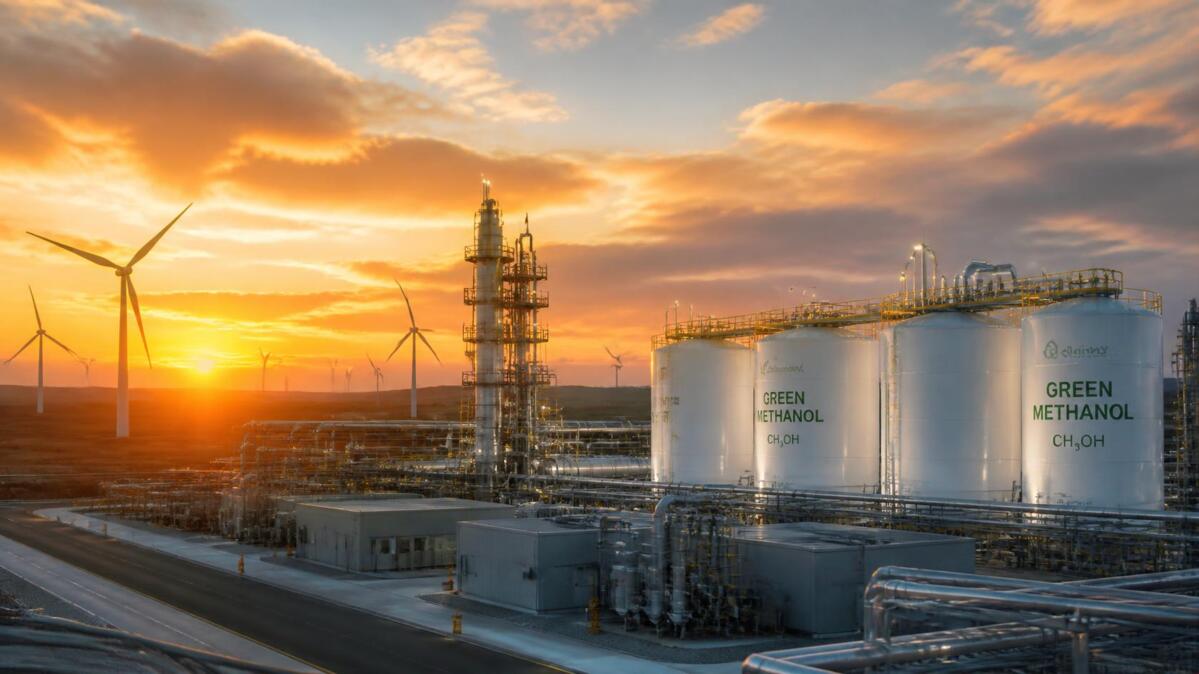
Featuring a planned annual capacity of 500,000 tonnes, the world's largest wind-powered green hydrogen-to-methanol project successfully achieved ISCC EU certification—the leading international scheme for sustainable and low-carbon fuels. This milestone not only unlocked access to the European green shipping fuel market for the client but also paved the way for multiple follow-on ISCC EU contracts for DQS.
Loading...
World's Largest Green Methanol Project Achieves ISCC EU Certification
Loading...
Goldwind Green Energy Chemicals (Xing'an League) Co., Ltd., a subsidiary of Goldwind Technology — one of the world's leading wind turbine manufacturers — set out to build a green hydrogen-to-methanol facility of unprecedented scale in Xing'an League, Inner Mongolia. The project uses wind power to produce green hydrogen, which is then combined with biomass-derived carbon sources to produce green methanol, a low-carbon marine fuel increasingly demanded by the global shipping industry as it decarbonizes under IMO and EU regulatory pressure.
Positioned as a flagship of China's "new energy-based hydrogen production+" industrial chain, the project was designed not only to serve the domestic market but to enter international supply chains — including green shipping fuel contracts with major global carriers. To do that, the methanol produced needed to meet the sustainability and greenhouse gas (GHG) reduction requirements recognized in the European Union and international shipping markets.
The Challenge
Exporting green methanol into Europe and into international bunkering and shipping fuel contracts requires more than a low-carbon production process — it requires independently verified proof. Buyers, shipping lines, and regulators increasingly require certification under ISCC EU, the scheme recognized under the EU Renewable Energy Directive (RED II/RED III) and widely used to demonstrate compliance with sustainability and GHG emissions-saving criteria for biofuels, bioliquids, biomass fuels, and renewable fuels of non-biological origin (RFNBO).
For a project of this scale and complexity, the certification challenge was significant:
- Feedstock traceability: demonstrating a fully documented chain of custody from biomass and renewable electricity inputs through to finished green methanol
- GHG emissions calculation: accurately calculating lifecycle greenhouse gas savings against the ISCC EU methodology and default values
- Mass balance system design: establishing a robust mass balance system capable of handling the scale and complexity of a multi-phase, 500,000-tonnes-per-year facility
- First-of-its-kind scale: as the largest project of its type globally, there was no directly comparable precedent to benchmark certification requirements against
- Time pressure: aligning certification timelines with the client's production ramp-up and international sales contract commitments
The DQS Solution
DQS was engaged as the certification body to guide Goldwind Green Energy Chemicals through the full ISCC EU certification process, combining technical rigor with practical, on-the-ground project management.
- Gap Assessment and Readiness Review
DQS auditors conducted a detailed review of the facility's feedstock sourcing, production process, and documentation systems against ISCC EU requirements, identifying gaps early and giving the client a clear roadmap to certification readiness.
- Mass Balance and Traceability System Verification
Given the scale of the project, DQS worked closely with the client's technical and sustainability teams to verify a mass balance system capable of tracking sustainable inputs through each stage of a multi-phase gasification and synthesis process, ensuring full chain-of-custody integrity from field to finished product.
- GHG Calculation Review
DQS auditors reviewed the project's greenhouse gas emissions calculations against the ISCC EU methodology, confirming the emissions savings claims that underpin the fuel's eligibility for the European market and shipping industry decarbonization targets.
- On-Site and Documentation Audits
A combination of on-site audits and documentation review verified that operational practices matched the systems described on paper — a critical step for a first-of-its-kind facility where standard operating procedures were still being finalized.
- Certification and Ongoing Surveillance
Following successful audit completion, DQS issued ISCC EU certification, with a surveillance program in place to support the client through subsequent production phases as capacity scales toward 1.45 million tonnes per year.
The Results
ISCC EU certification gave Goldwind Green Energy Chemicals independently verified proof of sustainability and GHG performance — the credential international buyers and shipping lines require before signing offtake agreements.
- Market access: Certification enabled the project's green methanol to be recognized as compliant sustainable fuel for the European and international green shipping market
- Global benchmark status: As the world's largest wind-powered green methanol project, the certified facility reinforced China's position in the global green fuel supply chain
- Repeat business: The successful project subsequently led to multiple new ISCC EU certification contracts for DQS within the same client group and industrial cluster, reflecting confidence in DQS's technical expertise and delivery
- Scalable framework: The certification approach established during this project created a template that supports the client's subsequent project phases as capacity expands
DQS is an accredited certification body for ISCC EU, supporting clients across the biofuels, green chemicals, and renewable fuels value chain. Our auditors combine deep technical understanding of mass balance systems and GHG methodology with practical experience guiding first-of-its-kind and large-scale projects through certification — helping clients turn sustainability performance into verified market access.
Contact DQS
Looking to certify your renewable fuel or green chemical project to ISCC EU?
Author
DQS Hong Kong
DQS – Leveraging Quality, Driving Success.
DQS empowers organizations worldwide to build trust, drive innovation, and achieve sustainable growth by certifying the future of business. Founded in 1985, DQS has grown into a global leader in the assessment and certification of management systems, with a team of 3,000 highly qualified auditors delivering over 130,000 audit days per year in more than 60 countries. Through internationally recognized certifications across 200+ standards, DQS helps businesses manage risks, ensure compliance, and unlock new opportunities in an evolving regulatory and business landscape.
Thinking beyond compliance, DQS is a trusted partner for digitalization, automation, and sustainability leadership. The company’s expertise covers a wide range of areas, spanning from cybersecurity and AI governance to ESG compliance, supply chain management, medical device safety, and future mobility, delivering real value to industries in their pursuit of resilient, sustainable, and intelligent systems. By leveraging advanced auditing methodologies, predictive analytics, and real-time insights, DQS supports organizations to future-proof their operations while demonstrating their commitment to excellence and responsible business practices.

Loading...