
ISO 14001 revision 2026
Overview of new requirements and adjustments
The globally recognized environmental management standard ISO 14001 is currently being revised. According to ISO, the updated version is due to be published in April 2026. The International Accreditation Forum (IAF) has already set a transition period of 36 months - this means that existing ISO 14001 certificates must be converted to the new version by April 2029 at the latest.
More than ten years after the last comprehensive revision, the International Organization for Standardization (ISO) is thus responding to changing conditions. Progressive climate change and the global transition to renewable energies require further development of the standard content in order to make environmental management systems fit for the future and even more strongly aligned with sustainability.
CONTENT
- ISO 14001 Revision 2026
- Where does the ISO 14001 revision currently stand?
- What are the changes in the ISO 14001 revision?
- ISO 14001 revision: What do you need to do now?
- Is there more information on the ISO 14001 revision?
- Why is DQS your first port of call for information on the ISO 14001 revision?
- Expert opinions: Why is the ISO 14001 revision important?
- What is the timetable for the ISO 14001 revision?
- Which important management system standards are still under revision?
- Revision of ISO 14001 - in brief
- Questions and answers about the ISO 14001 revision
Where does the ISO 14001 revision currently stand?
The revision process is already well advanced: After an initial draft for comment in February 2025, the Draft International Standard (ISO/DIS) followed in June. The Final Draft International Standard (ISO/FDIS) has been available since January 5, 2026.
On this page, you will find out what changes the ISO 14001 revision entails, what this means for an existing environmental management system and how you can prepare specifically for the changeover. ISO 14001:2026 is expected to be published in April 2026.
What are the changes in the ISO 14001 revision?
The revision of ISO 14001 does not provide for a fundamental reorientation, but mainly clarifications and specifications of existing requirements in the management system, especially in the informative Annex A. Current environmental developments such as climate change, greenhouse gas emissions, resource scarcity, the circular economy, SDGs and the European Green Deal are given greater consideration.
In April 2023, ISO published the results of a global user survey on ISO 14001. The aim of the survey was to assess the need to revise the currently valid ISO 14001:2015 from the users' perspective. Although many participants wanted more guidance and clarity in its application, the majority were against a fundamental revision of the standard.
Nevertheless, the responsible technical committee ISO/TC 207/SC 1 decided to initiate a revision of ISO 14001 - even before the official publication of the survey results. However, the changes mainly concern the informative Annex A, which means a cautious further development of the environmental standard.
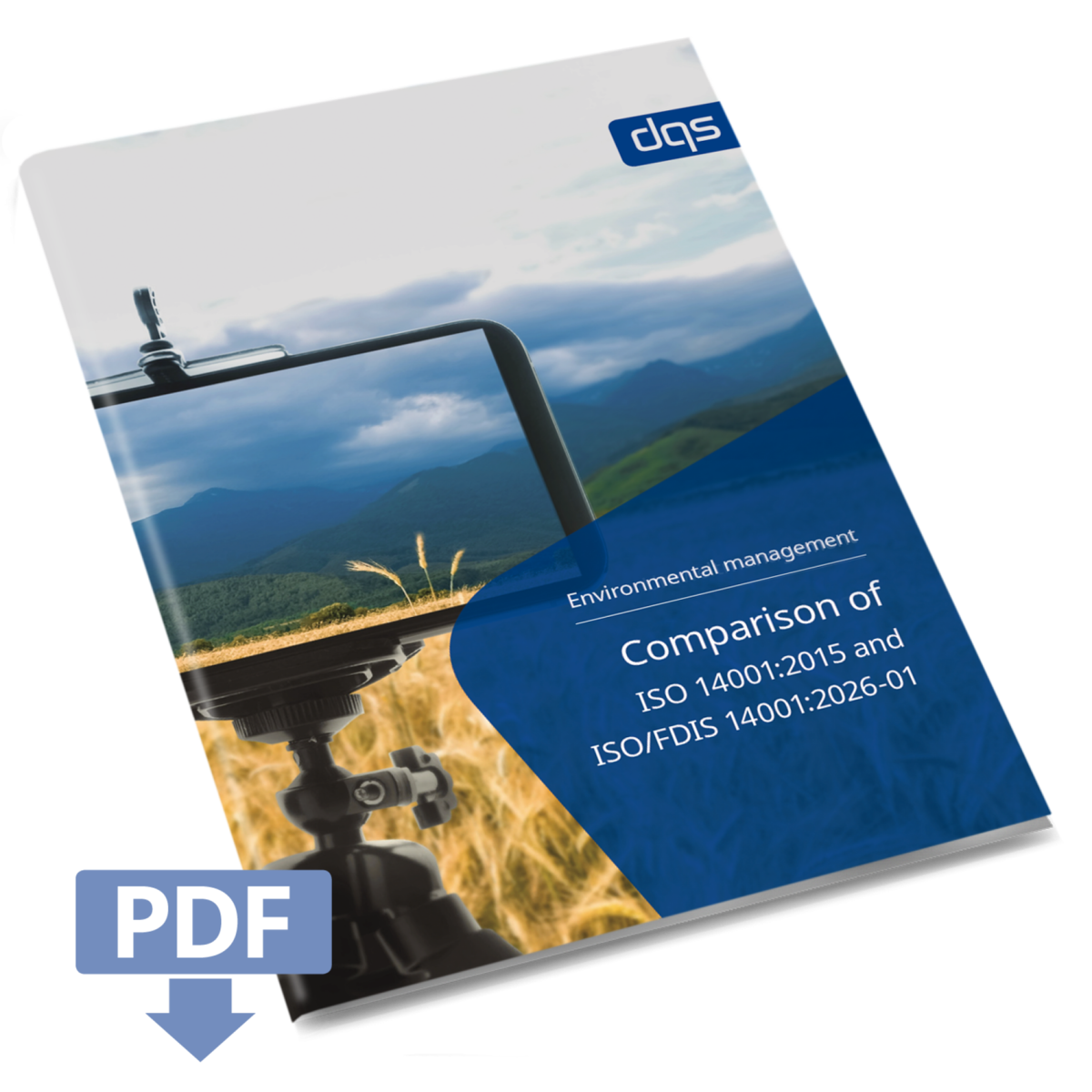
ISO 14001:2015 vs. ISO/FDIS 14001:2026
Our free comparison offers a structured comparison between existing and new standard requirements and clearly illustrates the differences between 2015 and 2026.
The ISO committee cites the numerous, in some cases significant, developments in the environmental sector in recent years as the main reasons for the revision:
- Progressive climate change
- Growing importance of greenhouse gas emissions
- Scarcity of natural resources
- Increasing use of renewable energies
- Requirements in the context of a functioning circular economy
In addition, the Sustainable Development Goals (SDGs) of the United Nations and the European Green Deal are to be more closely integrated into the context of the environmental standard in future. While the current ISO 14001:2015 focuses exclusively on the consideration of the life cycle of products and services, the content is expected to be expanded in the future in the overall context of sustainability.
ISO 14001 revision: What do you need to do now?
If you have already introduced an environmental management system in accordance with ISO 14001, we recommend use the FDIS for a pragmatic reality check, review relevant topics and prioritize two to three aspects from them and follow these up until the standard is published, as well as schedule internal audits and management reviews as fixed anchors for progress monitoring.
ISO 14001 revision: planning preparatory steps
As experience shows that internal processes cannot be adapted at short notice, it is advisable to start the transition activities in good time in order to manage the transition reliably.
- Clarify responsibilities
- Understand changes to the standard
- Carry out a gap analysis
- Plan and implement measures
- Train employees
- Check the effectiveness of the management system
- Determine audit date for certification
ISO 14001 Transition Plan (PDF)
Changes often raise new questions. To provide you with as much guidance as possible, we have compiled all relevant information regarding the Transition Plan. Use our concise PDF summary for a quick overview.
Why is DQS your first port of call for information on the revision of ISO 14001?
Founded in 1985 as the very first certification body for management systems in Germany, DQS has decades of experience and is closely networked with standardization bodies, professional circles and auditing practice. As a result, it is not only able to classify the revision of ISO 14001 in a technically sound manner. DQS sees itself as a supportive partner for both existing and new customers in the implementation and certification of the new standard. It supports companies in a practical and implementation-oriented manner, also with regard to certification cycles and transition periods as well as topics such as transfer audits or matrix certification.
Expert opinions: Why is the revision of ISO 14001 important?
The revision of ISO 14001 is important because it systematically integrates current environmental developments such as climate change, greenhouse gas emissions, resource scarcity and the circular economy into environmental management and thus strengthens the strategic sustainability of organizations.
What do experts say about the ISO 14001 revision?
Experts see the upcoming revision as a consistent further development of the standard, which anchors central topics such as SDGs and ISO 14001 or the European Green Deal more firmly and takes into account the increased expectations of transparency, risk and life cycle assessment.
In their view, it is less about a fundamental reorientation than a sharpening of the content and strategic classification of current environmental requirements. The experts emphasize that organizations should analyze and actively address the revision at an early stage in order to take advantage of opportunities, better manage risks and effectively further develop environmental management - instead of merely making formal adjustments.









What is the schedule for the ISO 14001 revision?
As with other management system standards, the revision of ISO 14001 follows a clearly structured ISO process that goes through several draft stages - from the Committee Draft (CD) to the Draft International Standard (DIS) to the Final Draft (FDIS). The new version is expected to be published in April 2026. We have illustrated the key milestones for you in a timeline:
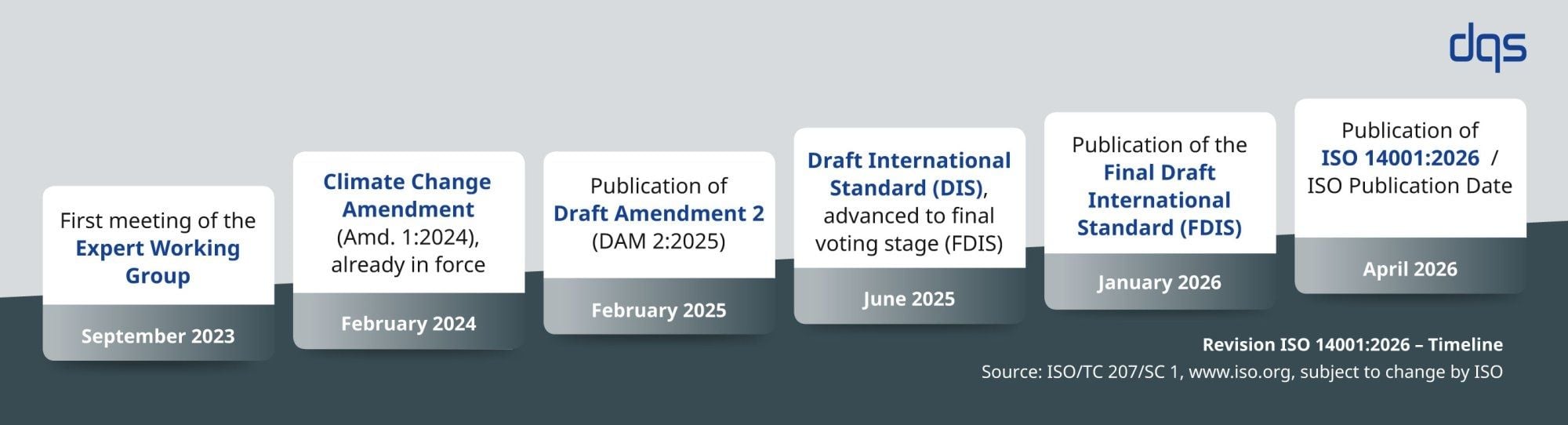
This project plan is intended to ensure that ISO 14001 is further developed in a coordinated, internationally consensual and practical manner. The revision process is coordinated by the responsible ISO committee ISO/TC 207/SC 1.
The subsequent transition period until spring 2029, during which existing environmental management systems must be converted to the new standard, is particularly relevant for certified companies. It is therefore advisable to review your own certification cycle at an early stage and to plan the transition strategically with DQS, for example as part of regular recertification audits.
What phases are there in the revision of an ISO management system standard?
The revision of an ISO management system standard follows a multi-stage, internationally coordinated process with several rounds of drafting, commenting and coordination until publication as a binding International Standard. The process takes several years, as over 160 member countries are involved, a formal consensus procedure is carried out, translations are made into numerous languages and the standard must be applicable in practice across industries and sizes worldwide.
What happens in the individual phases?
Working Draft (WD): First working draft within the committee, serves as a rough guide.
- Committee Draft (CD): First version, which is commented on and discussed internally within ISO.
- Draft International Standard (DIS): Mature draft that can also be commented on publicly for the first time - broad participation is possible here.
- Final Draft International Standard (FDIS): Almost final version, in which only editorial changes are still possible.
- International Standard (IS): Official publication by ISO - basis for certification.
Which important management system standards are still under revision?
There is currently a lot going on with the major international management system standards: in addition to the standard for environmental protection management, ISO 9001 for quality management and ISO 45001 for occupational health and safety management are also being revised, for example. Here is an overview:



Revision of ISO 14001 - in brief
The revision of ISO 14001, which is expected in April 2026, represents a targeted but cautious step towards more strategic environmental management. Instead of fundamental innovations, the focus is on clarifications and extended application notes - entirely in line with the wishes of users who, according to the User Survey Report 2021, want more support but no additional complexity.
Even if no far-reaching new requirements are introduced, the ISO 14001 update offers a valuable opportunity: companies can align their environmental management system with upcoming challenges. In the future, ISO 14001 will remain a stable foundation for environmental responsibility, sustainability and support for global climate goals. In the long term, this can contribute not only to improving environmental performance, but also to increasing competitiveness.
Use the transition period until 2029 now to analyze the upcoming changes with a view to the next certification and to review existing structures. The three-year transition period following the final publication of the standard offers sufficient time for this.
You can also read our blog post ISO 14001:2026 - the safe transition
Questions and answers about the ISO 14001 revision
ISO 14001:2026 is the planned, revised edition of the international standard for environmental management systems, which clarifies existing requirements and anchors current developments such as climate change, greenhouse gas emissions, resource scarcity, circular economy, SDGs, and the European Green Deal more firmly in environmental management.
ISO 14001 is being revised to respond to current environmental developments such as climate change, increasing climate protection requirements, resource scarcity, and the circular economy, as well as to clarify the technical aspects of the standard and develop it further for the future.
The revised ISO 14001 standard (ISO 14001:2026) is expected to be published in April 2026.
The final version of the new ISO 14001 will be available after its publication—expected in spring 2026—through national standards organizations, for example:
- in Germany through DIN
- in Austria through Austrian Standards
- in Switzerland via SNV
- and internationally via ISO itself
The most significant changes in ISO 14001:2026 primarily concern the clarification of existing requirements and the stronger anchoring of current environmental aspects such as climate change, greenhouse gas emissions, resource scarcity, circular economy, SDGs, and the European Green Deal—without fundamentally realigning the standard.
The new version is not expected to include any completely new basic requirements, but rather to tighten existing requirements and supplement them with stronger references to climate risks, greenhouse gas emissions, biodiversity, the circular economy, and expanded life cycle and impact assessments.

Do you have questions about the ISO 14001 revision?
We are here for you!
Where changes take place, questions often arise.
We look forward to clarifying these together with you. We will be happy to provide you with further information on request, particularly on topics such as transfer audits or matrix certification.
Find out more. Without obligation and free of charge.
Trust and expertise
Our texts and brochures are written exclusively by our standards experts or long-standing auditors. If you have any questions about the text content or our services to our author, please send us an e-mail: [email protected]
Note: For reasons of better readability, we use the generic masculine. However, the directive generally includes persons of all gender identities, insofar as this is necessary for the statement.