
Comparison of standard requirements
ISO 14001:2015 vs. ISO/FDIS 14001:2026-01
The revision of ISO 14001 specifies existing requirements and sets new technical priorities. While the basic structure remains the same, the final draft ISO/FDIS 14001:2026-01 specifies central content and strengthens topics such as climate change, biodiversity, life cycle perspective and change management.
This raises the question for companies: What are the main differences between ISO 14001:2015 and ISO 14001:2026 - and what are the implications for existing environmental management systems?
Our free white paper offers a structured comparison between existing and new standard requirements and presents the differences between 2015 and 2026 in a comprehensible way.
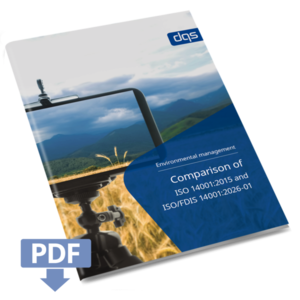
Created by our standards expert
- Precise comparison of standards: Tabular comparison of the requirements from ISO 14001:2015 and ISO/FDIS 14001:2026-01
- Transparency of changes: Overview of newly included, clarified and structurally adapted requirements in the final draft
- Impact analysis: Systematic classification of possible effects of the changes to the standard on certified environmental management systems
- Transition orientation: Structured basis for internal assessments in the run-up to the standard changeover
Background
Environmental management systems are subject to a continuous development process. In the course of the revision of ISO 14001, aspects such as climate change, biodiversity and the life cycle perspective in particular will be specified and anchored more firmly in the standard. At the same time, the basic structure of the standard is being retained, but individual requirements are being made more specific and thematically sharpened.
The free white paper is based on the final draft ISO/FDIS 14001:2026-01 and offers a structured ISO 14001 FDIS comparison between ISO 14001:2015 and the planned revision. The contents are clearly structured and enable a comprehensible classification of relevant changes.
Find out what is important in the free comparison.
Find out which adjustments are relevant and which topics will become more important in the future. Created on the basis of practical audit experience, the free white paper is aimed at environmental management officers and those responsible for environmental management who want to gain transparency about the upcoming changes at an early stage.

About the author
Kai Uwe Kaiser
The expert and auditor for numerous environmental and sustainability topics is DQS product manager for ISO 14001. Kai Uwe Kaiser has many years of practical experience in the automotive industry - from production and quality management to environmental, energy and occupational health and safety management to plant management. He contributes his in-depth expertise not only to audits, but also to training and a wide range of further training courses.