Why early action makes sense

ISO 14001:2026 is coming: The new version of the standard strengthens the strategic orientation of environmental management systems and places a stronger focus on topics such as life cycle assessment, climate risks and change management. For many organizations, this raises the key question of how to make the transition to ISO 14001:2026 safely and strategically.

ISO/FDIS 14001:2026 is already available and provides companies with reliable guidance for the upcoming changes. The transition period of 36 months officially confirmed by the International Accreditation Forum (IAF) begins with the expected publication in April 2026. Within this period, all existing certificates must be converted to the new version of the standard. Certificates in accordance with ISO 14001:2015 will therefore lose their validity in spring 2029.

The time frame for the transition is clearly defined and creates a reliable planning basis for certified organizations. Early and structured preparation facilitates integration into the existing certification cycle and ensures a stable, manageable transition.

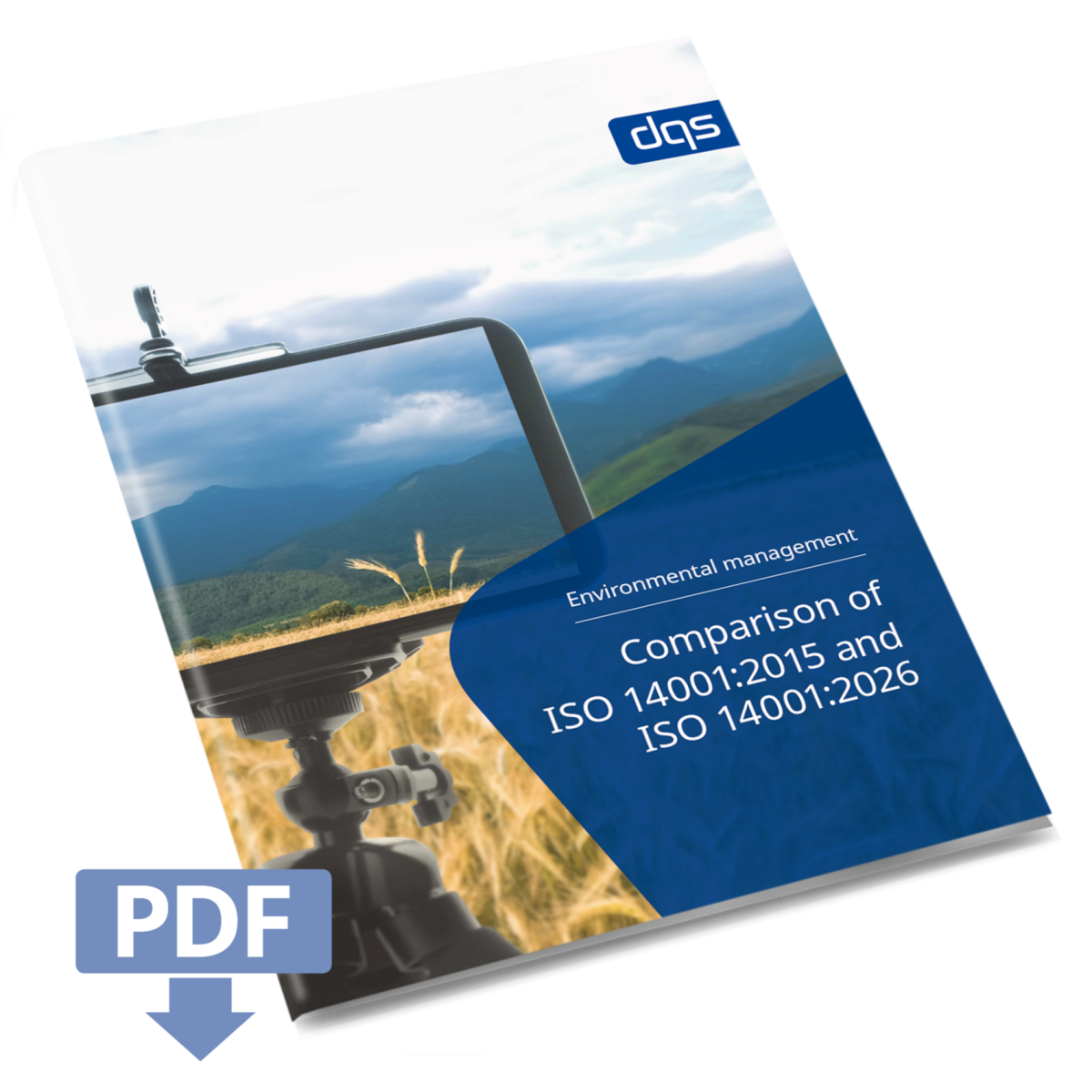
Title image of the English whitepaper on environmental management: Comparison ISO 14001:2015 vs ISO/
Loading...
Free white paper

ISO 14001:2015 vs. ISO/FDIS 14001:2026

Our white paper offers a structured comparison between existing and new standard requirements and clearly presents the differences between 2015 and 2026.

Current timeline - transition to ISO 14001:2026

The publication of ISO 14001:2026 is scheduled for April 2026. As with previous revisions, the transition period for the conversion of existing ISO 14001 certificates has been set at three years. This means that all certificates must be successfully converted to the new version of the standard by spring 2029 at the latest. Certificates according to the "old" DIN EN ISO 14001:2015 will then lose their validity.

The 36-month rule follows the internationally agreed IAF specification for management system revisions. Although it creates planning security, it also means that companies must decide early on when and in which certification cycle the changeover should take place. Those who do not start until 2028 risk not only time pressure and resource bottlenecks, but also unnecessary uncertainties in the audit process.

Important to know: Once the new version of the standard is published, a shortened validity period will automatically apply to all initial certifications in accordance with ISO 14001:2015.

Early action pays off

With this in mind, it is advisable to prepare for the transition early and in a structured manner - with a comprehensible transition plan, a well-founded gap analysis and a conscious decision as to when the changeover can be sensibly integrated into the existing certification cycle.

Transition audits must be planned in such a way that the transition can be completed in good time before the existing certificate expires and the certification decision can be made clearly.

ISO 14001 creates a uniform global framework for effective environmental management. The standard combines operational environmental management with strategic corporate orientation and is currently being revised as part of the ISO 14001 revision is currently being further developed. This creates resilient structures for sustainable development and a future-proof orientation of organizations.

Recommended steps for the transition

Based on the current final draft ISO/FDIS 14001:2026-01 (E DIN EN ISO 14001:2026), companies can systematically review the expected need for adaptation and initiate the first preparatory steps. An early examination of the future requirements creates transparency regarding necessary changes. As experience has shown that internal processes cannot be adapted at short notice, it is advisable to start the changeover activities in good time in order to manage the transition reliably.


What you can do today - 7 steps to a secure transition

1. Clarify responsibilities 
Appoint a team for the standard changeover and define clear responsibilities for planning, implementation and communication. Involving top management at an early stage supports the strategic direction and accompanies the change process.

2. Understand changes to standards
Keep yourself regularly informed about the status of the revision, the transition periods and the relevant changes. Use suitable sources of information such as our white papers, webinars or specialist events. Plan the changeover as a project at an early stage to avoid time pressure.

3. Carry out a gap analysis
Compare your existing environmental management system with the requirements of ISO/FDIS 14001:2026-01. In particular, check topics such as climate risks, biodiversity, change management and life cycle assessment. Also consider outsourced activities as well as upstream and downstream processes where control or influence is possible.

4. Plan and implement measures
Derive targeted measures from the results, for example for the assessment of environmental aspects, risk assessment, internal communication or operational control. Existing processes and internal audit cycles help to proceed efficiently.

5. Train employees
Raise awareness of new priorities at an early stage and qualify relevant teams through appropriate training and clear internal communication.

6. Check effectiveness internally
Check the implementation and effectiveness of the measures through internal audits and the subsequent management review.

7. Determine the audit date
Plan the transition strategically in the certification cycle and coordinate the necessary steps with DQS at an early stage.

Your safe transition to ISO 14001:2026 - Conclusion

There is still time until the expected publication of ISO 14001:2026 in April 2026 - but the content is already clearly defined. Organizations that address the requirements of ISO/FDIS 14001:2026 at an early stage will create a reliable basis for a structured and plannable transition within the confirmed transition period.

The revision places a stronger focus on key future issues such as climate risks, life cycle considerations, strategic involvement of top management and effective change management. This is not just about formal adjustments, but also about the further development of the environmental management system in terms of a resilient and future-oriented approach.

A proactively planned transition process ensures security in the certification cycle and at the same time opens up the opportunity to strengthen environmental management as an integral part of the corporate strategy.


DQS - the right partner right from the start

The transition to ISO 14001:2026 requires more than the formal adaptation of individual documents. What is needed is clarity about normative requirements, structured integration into existing management systems and a reliable certification decision within the specified timeframe. In this phase, the selection of the certification body is of particular importance.

DQS has been supporting international standard revisions for many years and has extensive experience in the assessment and further development of environmental management systems. The auditors work with a globally harmonized audit methodology and combine normative precision with a deep understanding of operational processes.

This results in an audit approach that focuses both on conformity with the new version of the standard and the practical effectiveness of the system.

As part of the transition, DQS also supports the strategic planning of the changeover date within the existing certification cycle and ensures a clear, comprehensible certification decision. This provides companies with reliability during the transition and expert support on the path to ISO 14001:2026.


questions-answers-dqs-question mark on wooden dice on table
Loading...
Where changes take place, questions often arise.

Do you have questions?

We are here for you.

We look forward to clarifying these together with you. We will be happy to provide you with further information on request, particularly on topics such as transfer audits or matrix certification.

Find out more - without obligation and free of charge

Trust and expertise

Our texts and brochures are written exclusively by our standards experts or long-standing auditors. If you have any questions about the text content or our services to our author, we look forward to hearing from you. contact with you.

Note: For reasons of better readability, we use the generic masculine. However, the directive includes persons of all gender identities where necessary for the statement.

Author

Kai-Uwe Kaiser

DQS Product Manager, auditor and expert in numerous environmental and sustainability topics. He has many years of practical experience in the automotive industry – ranging from production and quality management to environmental, energy and occupational health and safety management, as well as plant management. He contributes his extensive expertise not only in audits, but also in trainings and a wide range of professional development programmes.


Loading...

You Might Also Enjoy These Reads

Discover more articles that dive deep into related themes and ideas.
Blog
Loading...

The BEAM Plus Global Era is Here: How Green Certifications Unlock the Belt and Road Market for Manufacturers

Blog
Loading...

Carbon Neutrality Study of Hong Kong’s Knitwear Industry: From Calculation to Verification

Blog
Loading...

EPD, Product Carbon Footprint & LCA in Hong Kong: 2025 Sustainability Guide