
ISO 14001 Revision 2026
Overview of new requirements and adjustments
The well-known environmental management standard ISO 14001:2015 has been revised. The updated version was published in mid-April 2026. More than ten years after the last major revision, the International Organization for Standardization (ISO) is responding, among other things, to the ongoing impacts of climate change and the global transition to renewable energy.
In August 2026, DQS became the first German certification body to receive DAkkS accreditation according to the revised standard DIN EN ISO 14001:2026. DQS now offers certification audits based on the requirements of the new standard version. The International Accreditation Forum (IAF) has defined a 36-month transition period. This means that existing ISO 14001 certificates must be transitioned to the new version by 30 April 2029 at the latest.
In this article, you will learn about the key changes introduced by the revision of ISO 14001, what they mean for an existing environmental management system, and how you can prepare specifically for a smooth and secure transition to ISO 14001:2026.
Where does the ISO 14001 revision currently stand?
The revision process has been completed: Following an initial draft for comments in February 2025, the Draft International Standard (ISO/DIS) was published in June. The Final Draft International Standard (ISO/FDIS) was published on 5 January 2026, and the final ISO 14001:2026 has been available since mid-April 2026. The English version of the standard is available from ISO.
ISO 14001:2026-04 – Environmental management systems – Requirements with guidance for use
What are the changes in the ISO 14001 revision?
The revision of ISO 14001 does not represent a fundamental realignment of the standard. Instead, it primarily introduces clarifications and refinements to existing management system requirements, particularly in the informative Annex A. At the same time, current environmental developments such as climate change, greenhouse gas emissions, resource scarcity, and the circular economy (Circular Economy) are given greater consideration. In addition, the United Nations Sustainable Development Goals (SDGs) and the European Green Deal have been more explicitly integrated into the context of the environmental management standard.
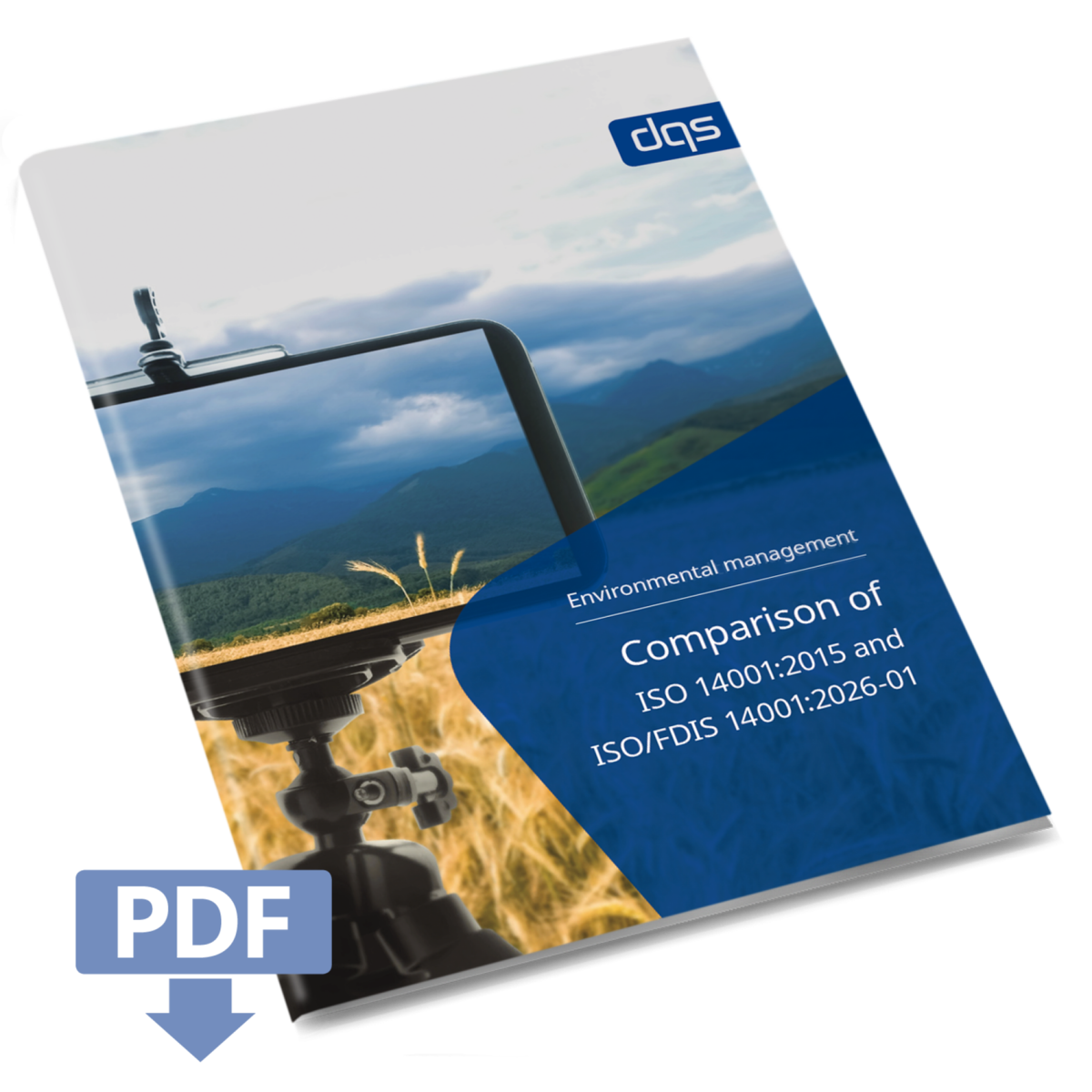
ISO 14001:2015 vs. ISO/FDIS 14001:2026
Our free white paper offers a structured comparison between existing and new standard requirements and clearly illustrates the differences between 2015 and 2026.
What are the specific changes introduced by the revision?
- Alignment of the standard text with the Harmonized Structure. The revised ISO 14001 follows the updated basic structure for management system standards in accordance with the ISO/IEC Directives, Part 1 – Annex SL (formerly: High Level Structure).
- Expansion and clarification of Clause 4.1: The ISO requirements on climate change from DIN EN ISO 14001/A1:2024-11 have been incorporated. This means that climate change must be assessed as a potentially relevant external issue, and climate-related expectations of interested parties must be taken into account. In addition, pollution, the availability of natural resources, biodiversity, and the condition of ecosystems are now explicitly mentioned.
- Introduction of a dedicated clause on planning changes (6.3). These requirements were previously addressed only under “Operational Planning and Control” (8.1).
- Standardization of requirements for documented information. A new requirement is that documented information must be available whenever needed, regardless of the medium or format. The terms “retaining” and “maintaining” have been removed.
- Editorial and structural revisions to standardize, refine, and clarify the requirements. New subclauses have been introduced, existing ones have been restructured, and notes have been adapted and supplemented. This provides greater transparency and traceability of the requirements, making the revised standard more practical and easier to interpret.
- Changes in terminology: For example, the phrase “this International Standard” has been replaced by “this document.”
- Annex A has been comprehensively revised and expanded to improve understanding of the requirements. Clearer requirements and additional guidance make the standard more practical and easier to apply.
ISO 14001 revision: What do you need to do now?
If you have already implemented an environmental management system in accordance with ISO 14001, you should use the published standard for a reality check, review relevant changes and prioritize key aspects. Continue to address these consistently within the transition period and plan internal audits and management reviews as fixed anchors for monitoring progress. Access the ISO 14001 transition plan here.
Plan the necessary steps
As internal processes cannot usually be adapted at short notice, it is advisable to start the transition activities early in order to manage the transition reliably.
- Clarify responsibilities
- Understand the changes to the standard
- Conduct a gap analysis
- Plan and implement measures
- Train employees
- Review the effectiveness of the management system
- Determine the timing of the ISO 14001 certification
ISO 14001 Transition Plan (PDF)
Changes often raise new questions. To provide you with as much guidance as possible, we have compiled all relevant information regarding the Transition Plan. Use our concise PDF summary for a quick overview.
Why is DQS your first point of contact for information on the revision of ISO 14001?
Founded in 1985 as the very first certification body for management systems in Germany, DQS has decades of experience and is closely networked with standardization bodies, professional circles and auditing practice. As a result, it is not only able to classify the revision of ISO 14001 in a technically sound manner. DQS sees itself as a supportive partner for both existing and new customers in the implementation and certification of the new standard. It supports companies in a practical and implementation-oriented manner, also with regard to certification cycles and transition periods as well as topics such as transfer audits or matrix certification.
Expert opinions: Why is the revision of ISO 14001 important?
The revision of ISO 14001 is important because it systematically integrates current environmental developments such as climate change, greenhouse gas emissions, resource scarcity and the circular economy into environmental management and thus strengthens the strategic sustainability of organizations.
What do experts say about the ISO 14001 revision?
Experts assess the revision as a consistent further development of the environmental management standard. It places greater emphasis on key topics such as the SDGs and ISO 14001 and the European Green Deal, while also addressing growing expectations regarding transparency, risk management, and a life cycle perspective. They emphasize that organizations should analyze and actively address the new version of the standard at an early stage in order to leverage opportunities, manage risks more effectively, and further develop their environmental management systems in an effective manner, rather than merely making formal adjustments.









What is the schedule for the ISO 14001 revision?
The revision of an ISO management system standard follows a multi-stage, internationally coordinated process involving several rounds of drafting, commenting, and voting before the standard is published as a binding International Standard. The new ISO 14001:2026 was published in mid-April 2026. We have illustrated the key milestones for you in a timeline:
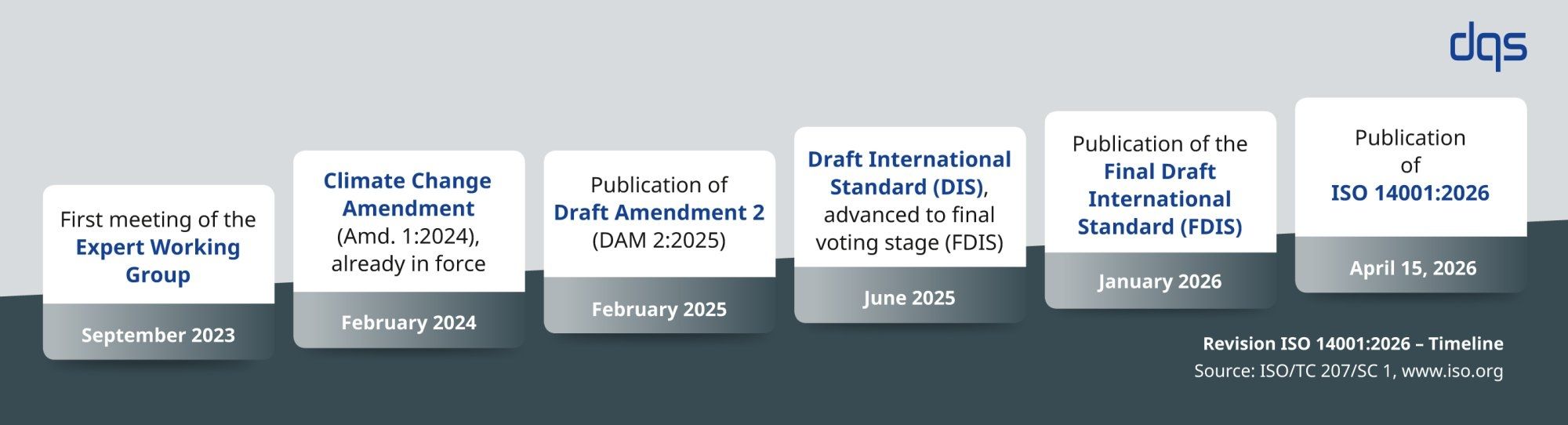
This process ensures that the new version of the standard is developed in a way that is technically sound, internationally agreed upon, and practical to implement. With more than 160 member countries involved and translations into numerous languages required, the revision process takes several years. It is coordinated by the responsible ISO committee, ISO/TC 207/SC 1.
What happens during the individual phases?
- Working Draft (WD): First working draft developed within the committee, serves as a rough guide.
- Committee Draft (CD): First version to be commented on and discussed within ISO.
- Draft International Standard (DIS): Mature draft that can also be commented on publicly for the first time - broad participation is possible here.
- Final Draft International Standard (FDIS): Almost final version, in which only editorial changes are still possible.
- International Standard (IS): Official publication by ISO - basis for certification.
Which other important ISO management system standards are currently being revised?
There is currently a lot happening with the major international management system standards. In addition to the environmental management standard, ISO 9001 for quality management and ISO 45001 for occupational health and safety management are also being revised. Here is an overview:



Revision of ISO 14001 – in brief
The ISO 14001:2026-04, published in mid-April 2026, represents a targeted yet measured step towards a more strategic approach to environmental management. Rather than introducing fundamental changes, the focus is on clarifying existing requirements and providing additional guidance on their application – with users in mind.
Although no far-reaching new requirements have been introduced, the ISO 14001 update provides a valuable opportunity to align the environmental management system with future challenges. ISO 14001 will continue to provide a stable foundation for environmental responsibility and sustainability, while supporting global climate goals. In the long term, this can contribute not only to improved environmental performance, but also to greater competitiveness.
The context of the organization is also given greater emphasis, particularly with regard to environmental conditions and their interactions that may affect the organization or be affected by it. The links between risks and opportunities, environmental aspects, compliance obligations, and strategic considerations are also highlighted more clearly, supporting a systematic and integrated approach to environmental management.
For certified organizations, the transition period until 30 April 2029 is particularly relevant. Existing ISO 14001 certificates must be transitioned to the new standard version by this date. Organizations should therefore analyze the upcoming changes and review their existing structures. The three-year transition period provides sufficient time to align the transition with the existing certification cycle and plan the transition with DQS. With its DAkkS accreditation, DQS can now offer accredited certification audits based on the requirements of the new standard version.
You may also be interested in our article ISO 14001:2026 – A Smooth Transition.
Questions and answers about the ISO 14001 revision
ISO 14001:2026 is the fourth revised edition of the international standard for environmental management systems. It clarifies existing requirements and further reflects current developments such as climate change, greenhouse gas emissions, resource scarcity and the circular economy within environmental management.
ISO 14001 has been revised to respond to current environmental developments such as climate change, increasing requirements for climate protection, resource scarcity and the circular economy, as well as to clarify the standard technically and facilitate its application.
ISO 14001:2026 was published on 15 April 2026.
The final version of ISO 14001:2026 is available from national standards bodies, for example:
- in Germany through DIN
- in Austria through Austrian Standards
- in Switzerland via SNV
- and internationally via ISO itself
The most significant changes in ISO 14001:2026 primarily concern the clarification and refinement of existing requirements, as well as a stronger emphasis on the context of the organization, particularly with regard to environmental conditions and their interactions. The links between environmental aspects, compliance obligations, risks, and opportunities are also highlighted more clearly – without fundamentally changing the overall approach of the standard.
No entirely new fundamental requirements have been introduced in the new version. Instead, existing requirements have been refined and supplemented with stronger references to climate risks, greenhouse gas emissions, biodiversity, the circular economy, as well as an enhanced life cycle perspective and consideration of influence.

Do you have questions about the ISO 14001 revision?
We are here for you!
Where changes take place, questions often arise.
We look forward to clarifying these together with you. We will be happy to provide you with further information on request, particularly on topics such as transfer audits or matrix certification.
Find out more. Without obligation and free of charge.
Trust and expertise
Our texts and brochures are written exclusively by our standards experts or long-standing auditors. If you have any questions about the text content or our services to our author, please send us an e-mail: [email protected]
Note: For reasons of better readability, we use the generic masculine. However, the directive generally includes persons of all gender identities, insofar as this is necessary for the statement.