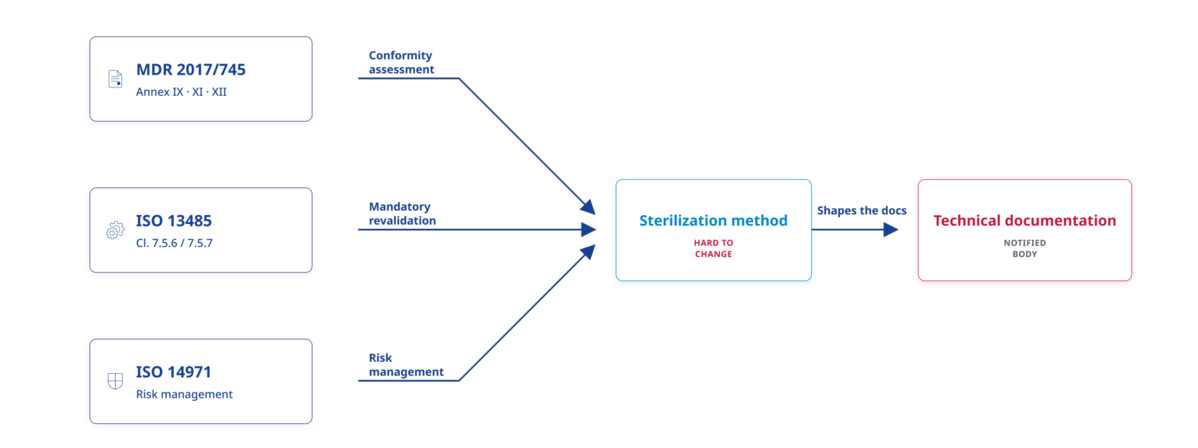
Diagram showing MDR, ISO 13485, and ISO 14971 converging on the sterilization method decision, which shapes the technical documentation reviewed by a Notified Body

Loading...
Choosing a sterilization method for a medical device is rarely just a technical decision, it shapes your validation burden, your packaging design, your supply chain, and how a Notified Body will read your technical documentation. Get it wrong, or leave it poorly justified, and it becomes one of the most common sources of audit findings under the Medical Device Regulation EU 2017/745.
This guide walks through the three sterilization methods that cover the large majority of medical devices on the market, ethylene oxide, radiation, and moist heat, what each governing standard requires, how they're validated, and how to think about choosing between them.
Why sterilization method selection is a regulatory decision, not just a technical one
Under the Medical Device Regulation (MDR) EU 2017/745, sterilization validation and routine control form part of the technical documentation reviewed under Annex II, and - for sterile devices - are directly tied to the conformity assessment route under Annex IX or XI. ISO 13485 (clause 7.5.6) requires manufacturers to validate and maintain records for processes, including sterilization, whose results cannot be fully verified by subsequent monitoring alone; clause 7.5.7 adds particular requirements for validating sterilization processes and sterile barrier systems, including mandatory revalidation whenever the process or product changes. And under ISO 14971, sterilization isn't a standalone technical exercise, it needs to be integrated into the device's overall risk management file, since the chosen method interacts with material biocompatibility, packaging integrity, and labeling claims.
In practice, this means the sterilization method a manufacturer chooses early in development (sometimes based mainly on cost or contract sterilizer availability) ends up shaping a large portion of the technical documentation a Notified Body will scrutinize later. Revisiting that choice after design freeze is expensive; understanding the requirements up front is not.
Ethylene oxide (EO) sterilization: ISO 11135
Ethylene oxide (EO) sterilization remains one of the most widely used methods for medical devices, particularly for products that cannot tolerate heat, moisture, or radiation — complex electronic components, certain polymers, and multi-material assemblies.
ISO 11135 sets out requirements for developing, validating, and routinely controlling an EO sterilization process. Two validation philosophies are commonly used:
• Overkill approach: the process is validated to deliver a substantial safety margin beyond what the product's actual bioburden would require, without needing precise bioburden characterization for every product family.
• Bioburden/biological indicator combination approach: validation is based on the product's actual, characterized bioburden together with biological indicator challenge data, allowing a more tailored (often shorter) cycle — at the cost of needing tighter, ongoing bioburden monitoring.
Whichever approach is used, validation must demonstrate that gas concentration, humidity, temperature, and exposure time consistently achieve the required Sterility Assurance Level (SAL) across the full range of the load — not just at a single "typical" configuration.
EO sterilization comes with a requirement that other methods don't: residual gas control. Because EO and its by-product ethylene chlorohydrin (ECH) are toxicologically relevant, manufacturers must demonstrate that residuals fall within allowable limits before the device is released. This is governed by ISO 10993-7, revised in its third edition in April 2026, which shifted the standard from a purely limit-value-based approach to an exposure- and risk-based assessment. We cover this change in detail in our article on ISO 10993-7:2026 and EO sterilization residuals.
Radiation sterilization: ISO 11137
Radiation sterilization (gamma, electron beam, or X-ray) is often chosen for devices that can tolerate ionizing radiation but not the heat and humidity of steam, or for high-throughput manufacturing where EO's longer cycle times are impractical.
ISO 11137 is published in three parts:
• Part 1 (current edition 2025) sets requirements for development, validation, and routine control of the sterilization process.
• Part 2 provides methods for establishing a sterilization dose, including the widely used VDmax approach, which allows manufacturers to substantiate a standard dose based on product bioburden category rather than running a full dose-setting experiment for every product.
• Part 3 provides guidance on the dosimetric aspects of development, validation, and routine control (dosimeter calibration, dose mapping, measurement uncertainty). Dose auditing itself — periodically confirming that the originally validated dose remains appropriate as manufacturing conditions evolve — is a routine-control requirement addressed in Parts 1 and 2.
Dose auditing is a frequent audit focus area, precisely because it depends on an accurate, current understanding of a product's bioburden, which can drift as manufacturing processes, suppliers, or raw materials change without anyone flagging it as a "sterilization-relevant" change.
Moist heat / steam sterilization: ISO 17665
Steam sterilization — pressurized saturated steam, typically between 121°C and 134°C — remains the preferred method for reusable surgical instruments and any device that tolerates heat and moisture. It is comparatively simple and fast, and avoids the residual and dose-substantiation burden that comes with EO and radiation.
ISO 17665 (current edition 2024) centers validation on physical qualification - proving that the autoclave load reaches and holds the required temperature throughout the cycle, in every position of the load - paired with biological indicator challenge testing, typically using Geobacillus stearothermophilus spores. As with the other methods, routine control matters as much as initial validation: every production cycle needs monitored, recorded parameters, not periodic spot checks.
Comparing the three methods
| Ethylene Oxide (ISO 11135) | Radiation (ISO 11137) | Steam (ISO 17665) | |
|---|---|---|---|
| Best suited for | Heat/moisture-sensitive devices, complex assemblies | High-throughput production, radiation-tolerant materials | Reusable instruments, heat/moisture-tolerant devices |
| Cycle time | Hours to days (including aeration) | Minutes to hours | Minutes to a few hours |
| Key validation focus | Gas/humidity/temperature distribution, residuals | Dose-setting (VDmax) and dose auditing | Physical qualification, biological indicators |
| Standard-specific burden | Residual EO/ECH testing (ISO 10993-7) | Ongoing bioburden monitoring for dose audits | Comparatively low — no residuals to manage |
| Common audit finding | Incomplete residual justification; missing revalidation trigger | Dose audit not reflecting current bioburden | Missing or non-representative biological indicator placement |
Packaging: the piece that's easy to treat as an afterthought
A validated sterilization process only protects a patient if the device is still sterile when it reaches them. That depends on the sterile barrier system, the packaging that maintains sterility until use, which is governed by ISO 11607, covering both material and system performance requirements and the validation of forming, sealing, and assembly processes. Changing a sterilization method, a sterilization provider, or even a packaging material supplier can each independently trigger a need to revisit packaging validation, a connection that is often missed because sterilization and packaging are owned by different teams internally.
Medical Device Packaging for Sterilization
For hands-on packaging validation training, see our workshop!
Method availability isn't guaranteed — build in resilience
Sterilization method selection isn't purely a technical exercise; it's also a supply chain decision. Sterilization capacity, environmental regulation, and contract sterilizer availability have all shifted meaningfully in recent years for at least one of the three methods covered here, and manufacturers who depend on a single method, site, or provider carry more exposure to disruption than those with a validated alternative.
Where to go deeper
Each of these standards is deep enough to justify its own training. Our training Sterilization of Medical Devices: Regulatory and Best Practices, led by Barbara Peter, Technical File Reviewer and QMS auditor at DQS Medizinprodukte GmbH, covers all three methods, how they map to MDR Annex II documentation expectations, and the audit findings we see most often as a Notified Body. Sessions run online on 18 January, 4 May, and 7 October 2027.
Frequently Asked Questions
What is Sterility Assurance Level (SAL), and why does it matter for method selection?
SAL is the statistical probability that a single viable microorganism survives on a device after sterilization, typically required to be 10⁻⁶ for most medical devices. All three methods covered here can achieve this SAL, but the validation evidence required to demonstrate it differs significantly by method, which is why "method X is easier to validate" is only true relative to a specific device and manufacturing context.
How do I know which sterilization method is right for my device?
The decision depends on device materials, geometry, packaging configuration, intended reuse (single-use vs. reusable), production volume, and sterilization provider availability. There is rarely a single "correct" answer — the goal is a method that is technically compatible with the device and that can be robustly, repeatably validated and documented.
Does DQS training cover EO residual requirements under ISO 10993-7:2026?
Yes, our training Sterilization of Medical Devices: Regulatory and Best Practices covers the current regulatory requirements for sterilization residuals, including the shift introduced by the third edition of ISO 10993-7.
How often does a sterilization process need to be revalidated?
There's no fixed universal interval — revalidation is triggered by defined changes (to the device, materials, packaging, load configuration, sterilization provider or site, or bioburden profile) rather than by a calendar alone, though periodic review (and, for radiation, periodic dose auditing) is expected as part of routine control.
Does a Notified Body evaluate sterilization specifically, separately from the rest of the technical documentation?
Sterilization validation and routine monitoring are reviewed as part of the technical documentation under MDR Annex II, alongside, not instead of, the overall risk management file and packaging validation. Reviewers specifically look for traceability between the validated process, the documentation, and any changes that have occurred since validation.
About this article
This article was reviewed and validated by Klaus Lindenberg, Auditor and Technical File Reviewer at DQS Medizinprodukte GmbH, with specialist expertise in the sterilization of medical devices.