Two weeks ago, the compliance timelines that many companies used to map out their AI roadmaps got completely rewritten. The EU Digital Omnibus on AI (Regulation (EU) 2026/1744) was published in the Official Journal on July 24, 2026, and went live three days later—cutting it close right before the full rollout of the AI Act on August 2. Compliance deadlines for standalone high-risk systems under Annex III—covering things like hiring, credit scoring, and education—have been pushed from August 2, 2026, all the way to December 2, 2027. Meanwhile, AI embedded in regulated products (Annex I) has been kicked down the road to August 2, 2028.
Loading...
EU AI Grace Period Extended by 16 Months: How Businesses Can Cut the Red Tape and Balance Governance with Speed

Loading...
On the surface, catching a 16-month breather feels like a massive sigh of relief. But treating this extension as a free pass to hit snooze on your compliance efforts will cost you big time down the line.
Here’s the catch: the foundational architecture of the AI Act remains completely untouched. The risk-tiering system, the banned practices that kicked off back in February 2025, and the general-purpose AI rules that rolled out in August 2025 are all staying right on schedule. Transparency requirements still land on August 2, 2026, with just a short grace period running out on December 2, 2026 (alongside a brand-new ban on AI systems cooking up non-consensual deepfake intimate imagery). What the EU actually delayed are conformity assessments, technical documentation, and registration—the brutal heavy lifting of paperwork and tech engineering that no organization could realistically wrap up in a single quarter.
More importantly, a delayed regulatory deadline doesn't change your risk exposure. Whenever those files eventually land on a desk, every single call your AI systems make today is going to be scrutinized by regulators, clients, and courts. This extra 16-month window isn't a cue to pause; it’s your golden opportunity to bulletproof your internal governance and streamline your approval workflows (take a look at the official EU AI Act Implementation Timeline & Updates for the latest tracker).
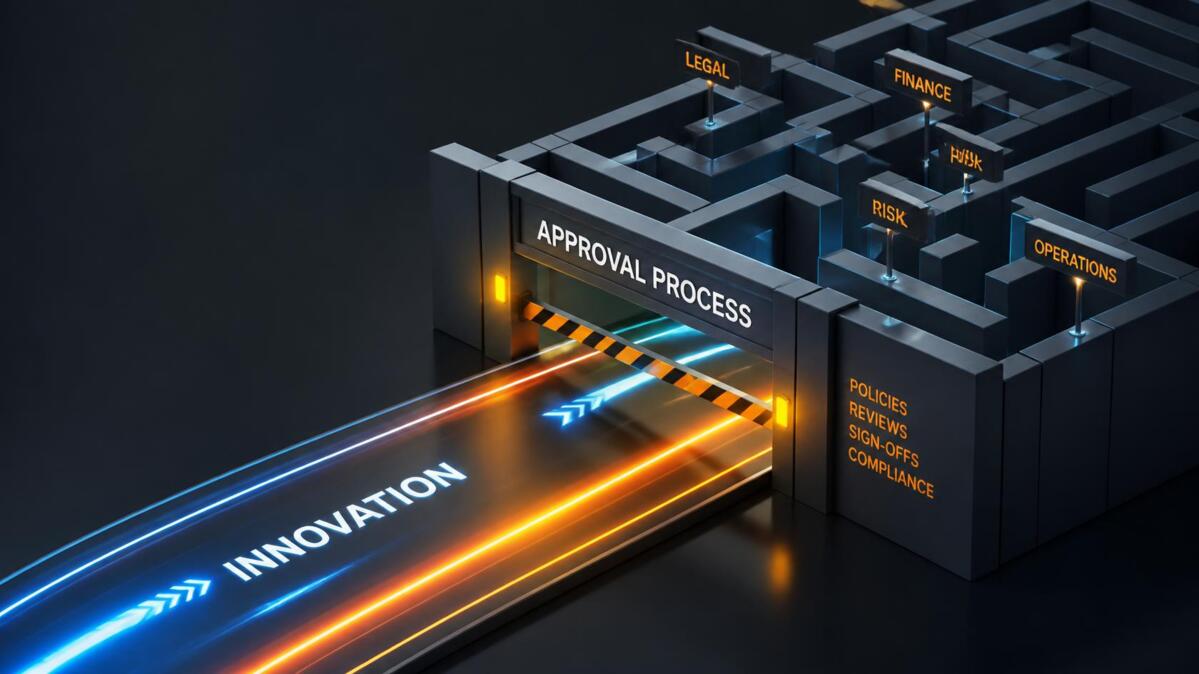
The Root Cause of the Bottleneck: When Approvals Kill Innovation
Since the external calendar just bought you some breathing room, it’s the perfect time to fix a blind spot that trips up businesses every single day.
Step into almost any internal strategy meeting, and you’ll hear that familiar, panicked question: "How do we govern AI without pumping the brakes on innovation?" That question is built on a broken premise—the assumption that "governance" and "speed" are locked in a zero-sum tug-of-war, where every ounce of safety automatically bleeds away your velocity.
In reality, that's rarely how it plays out. In most companies, what actually strangles AI deployment isn't the presence of guardrails, but the total lack of clear decision rights and a fog of blurred accountability.
Picture a standard corporate bottleneck: A product team wants to roll out a new customer-facing feature powered by a fresh model. Who signs off? Legal assumes IT has it covered; IT figures it's a job for the Data Protection Officer (DPO); and the DPO has no idea the project even exists. Three weeks evaporate in an endless loop of calendar invites. At the end of the day, no risk assessment happened, zero controls were put in place, and all those weeks of gridlock generated precisely zero value.
That is the true, hidden tax of poor innovation management. When teams know upfront which tier their use case falls into, who actually owns the sign-off, what proof is required, and roughly how long the process takes, they fly through development faster than stumbling around in the dark. In business innovation, "uncertainty" will always kill momentum way faster than any strict process.
As highlighted in DQS's Expert Analysis on the EU AI Act, one of the core intents of standards like ISO/IEC 42001 is to establish an "AI governance structure with clear roles and accountability mechanisms." In most unstructured organizations, delayed deployment stems not from controls themselves, but from decentralized responsibilities and blurred lines of authority.
As further pointed out in the DQS AI Assurance Services & ISO 42001 Overview, when auditing and approval workflows are fragmented across siloed departments, organizations inevitably fall into a trap of mutual deflection. Weeks are wasted in endless alignment meetings, ultimately leaving risks unevaluated and controls unimplemented—achieving nothing except delay.

Loading...
The Side Effect of Bureaucracy: Fueling "Shadow AI"
When internal compliance processes get bogged down in bureaucratic quicksand, companies invariably trigger a dangerous second-order effect.
If getting an official green light for an internal AI tool takes six weeks, high-velocity teams operating under tight deadlines aren't going to sit around twiddling their thumbs. They’ll just open up a personal account on a public chatbot, dump in client spreadsheets to draft summaries, clean datasets, or write contract clauses. The job gets done, but every single enterprise security and compliance protocol gets completely bypassed.
This is Shadow AI—the sneaky, high-stakes vulnerability created when employees bypass corporate gatekeepers in the name of efficiency and upload sensitive internal data to unverified, public AI platforms. You can dig deeper into this threat in DQS's dedicated breakdown: Hong Kong AI Data Leakage and Shadow AI Risk Mitigation.
This brings us to a counterintuitive management reality: When approval processes cross a certain threshold of red tape, heavy-handed governance actually destroys visibility and skyrockets your overall risk. An organization running a lightweight registration process that captures 90% of active employee AI tools is miles safer than one sporting an oppressive, bureaucratic fortress that only achieves 40% visibility. The latter is sitting on a mountain of pristine compliance paperwork while flying blind to massive operational risks.
The Office of the Privacy Commissioner for Personal Data (PCPD) in Hong Kong captures this exact operational logic in its guidance and checklists (see the PCPD Checklist on Guidelines for the Use of Generative AI by Employees): blanket bans fail against real-world operational pressure; the secret is pairing practical internal policies with sensible operational enablement.

Loading...
Simplifying the Path: Precision Tiers Based on Consequences
To break out of the approval gridlock and stamp out Shadow AI, businesses have to ditch the one-size-fits-all playbook. Slapping the exact same heavy-duty review process onto every single AI experiment guarantees one of two things: either teams go underground out of pure frustration, or you miss fatal risks because you treated every project with the exact same weight.
The yardstick for deciding how hard to vet an AI project should never be "how cool or bleeding-edge the model is," but rather "if this thing goes sideways, who takes the hit and what's the human fallout?"
Before mapping out your review pipelines, enterprises can leverage the DQS Whitepaper on Responsible AI Governance under ISO 42001 as a practical blueprint for building out internal evaluation standards.
A lean, three-tiered model that balances agility with ironclad safety looks like this:
- Register Only: Built for internal productivity tools that touch zero personal data, have no customer interactions, and hold zero decision-making power. The sole goal here is "visibility," not red tape. Registration should take under five minutes—if the paperwork gets clunky, it defeats the entire purpose.
- Assess Before Deployment: Designed for any system that interfaces with customers, crunches personal data, or directly influences decisions impacting real people. Impact assessments, human-in-the-loop safeguards, and thorough testing land right here.
- High-Level Sign-Off: Reserved for systems that shape or execute high-stakes life decisions—such as hiring, credit scoring, insurance underwriting, healthcare diagnosis, or access to essential services. This sits right in the sweet spot of global regulatory consensus and mirrors the Annex III buckets recently deferred (not scrapped) by the EU.
Three Non-Negotiable Zones That Demand a Slower Pace
While the name of the game is agility and lightweight workflows, smart organizations know which lines they can't afford to rush. You need to pump the brakes and give these three areas serious, deliberate thought:
- Irreversible Decisions: Training models on datasets that can't be cleanly audited or plugging autonomous systems into workflows that lack an instant, bulletproof rollback button. The rule of thumb: if you can't undo it easily, you better vet it thoroughly upfront.
- Decisions Impacting Individual Rights: System outputs that directly dictate whether someone gets a job, a loan approved, an insurance payout, or access to a service. Hong Kong regulators have made their stance crystal clear: the HKMA expects robust "human-in-the-loop" safeguards across high-impact AI use cases, ensuring customers have clear opt-out avenues and mandating human intervention for generative AI outputs.
- Silent Failures: This is the ultimate blind spot everyone overlooks. System crashes make noise and announce themselves, but "model drift"—where accuracy quietly decays or bias creeps in against specific demographic groups—can hum along behind the scenes for months while your dashboards flash green lights all across the board. If you can't explain how you catch a model secretly going rogue, having a file cabinet full of compliance binders is completely useless.

Loading...
Regional Insights: The Mature Regulatory Expectation Across APAC
It’s a common trap for companies to assume that because Hong Kong doesn't have a standalone, blanket AI statute on the books, regulatory expectations are loose. That completely misreads a remarkably mature and forward-looking regulatory landscape.
The Office of the Privacy Commissioner for Personal Data (PCPD) has dropped the Artificial Intelligence: Model Framework for Personal Data Protection Official Press Release & Document Page, crafted in partnership with the Office of the Government Chief Information Officer (OGCIO) and the Hong Kong Applied Science and Technology Research Institute (ASTRI). Anchored around core business processes, it starts right where it should: treating high-level strategy—complete with clear roadmaps and intended use cases—as an enterprise-wide responsibility that cascades all the way down to vendor management and incident response playbooks.
This framework is backed by the PCPD's Ethical AI Guide and Employee Generative AI Checklist, alongside the Digital Policy Office’s Guidelines on the Application and Use of Generative AI in Hong Kong Official Release Page.
In the financial sector, these expectations have already moved off the drawing board and into daily operations. The HKMA’s High-Level AI Principles cover governance, accountability, fairness, transparency, disclosure, and data privacy (check out the HKMA Official Guidelines Page on Artificial Intelligence Applications and High-Level Principles), marking a decisive shift from high-level philosophy to gritty operational reality. Programs like the ongoing "GenA.I. Sandbox" and its major expansion via the HKMA GenA.I. Sandbox++ Formal Arrangements and Circular PDF Document spanning securities, asset management, insurance, MPF, and stored value facilities actively require proactive AI governance, automated quality checks, and adversarial stress-testing against deepfake fraud.
The message coming from regulators leaves zero room for ambiguity: nobody cares if you have nice-sounding AI principles on a slide deck anymore. They want to see your governance engine humming in production.

Loading...
The Power and Limits of ISO/IEC 42001: The PDCA Engine
When you're shopping around for governance frameworks, it pays to keep a clear head. AI management system certifications get hyped up a lot, but they come with clear boundaries:
The ISO/IEC 42001 won't magically tell you whether any given model is accurate, fair, or free from bias. It’s a management system standard—it doesn't test code outputs, and a certificate should never be waved around as a blank check guaranteeing absolute AI safety.
What it does give you is the exact piece of machinery most organizations are desperately missing: structured decision pathways driven by a continuous improvement PDCA cycle. It nails down AI roles and accountability, standardizes impact assessment triggers, operationalizes documented objectives, and sets up real-world incident response protocols. It completely cuts out those frustrating "three weeks of meetings for zero output" deadlocks and turns compliance into a dynamic, evolving process rather than a one-off paperwork exercise.
It also scales effortlessly when things get complex. Whether you're prepping for the EU's delayed deadlines kicking in by late 2027, answering audits from Hong Kong regulators, or trying to check every box on an enterprise client's vendor security questionnaire during a high-stakes pitch, having a certified AI management system gives you an immediate competitive edge. For a deeper dive, check out DQS's analysis on Why ISO 42001 is a Strategic Upgrade to ISO 27001.
If your models handle personal data, the ISO 27701 snaps privacy controls right onto the same architecture, while the ISO 27001 locks down your foundational security baseline (for a closer look at foundational security practices, check out the DQS SME Cybersecurity Guide).
Two Metrics That Actually Tell You If Governance Is Working
Most corporate AI compliance reports measure vanity metrics: how many policies were drafted, how many training webinars were run, or how many alignment meetings got scheduled. None of those numbers prove your governance is working—in fact, activity charts often shoot straight up while hidden operational risks are quietly blowing up in the background.
If you want a genuine pulse on whether you're balancing speed and safety, track these two metrics side by side:
- Median time from AI use case submission to final sign-off: If low-risk projects are sitting in a queue for weeks, your internal process is actively manufacturing shadow AI at scale, rendering all your compliance dashboards pure fiction.
- The actual registration ratio of active AI usage in production environments: A brutally honest assessment factoring in all those departmental SaaS tools and developer side-projects. If this number starts dipping, it's a flashing red warning light that your process has become so clunky that employees are deliberately routing around it.
Always look at these two metrics together. Tracking either one in isolation lets people game the system by sacrificing the other—which is precisely why they belong in tandem.
Frequently Asked Questions (FAQs)
Author
DQS Hong Kong
DQS – Leveraging Quality, Driving Success.
DQS empowers organizations worldwide to build trust, drive innovation, and achieve sustainable growth by certifying the future of business. Founded in 1985, DQS has grown into a global leader in the assessment and certification of management systems, with a team of 3,000 highly qualified auditors delivering over 130,000 audit days per year in more than 60 countries. Through internationally recognized certifications across 200+ standards, DQS helps businesses manage risks, ensure compliance, and unlock new opportunities in an evolving regulatory and business landscape.
Thinking beyond compliance, DQS is a trusted partner for digitalization, automation, and sustainability leadership. The company’s expertise covers a wide range of areas, spanning from cybersecurity and AI governance to ESG compliance, supply chain management, medical device safety, and future mobility, delivering real value to industries in their pursuit of resilient, sustainable, and intelligent systems. By leveraging advanced auditing methodologies, predictive analytics, and real-time insights, DQS supports organizations to future-proof their operations while demonstrating their commitment to excellence and responsible business practices.

Loading...