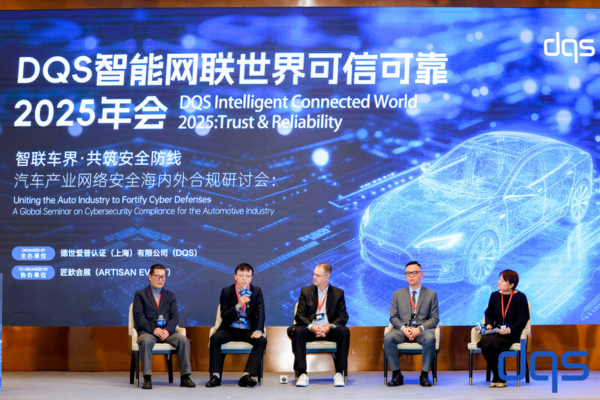
Global Insights: AI Safety and Evolving Standards
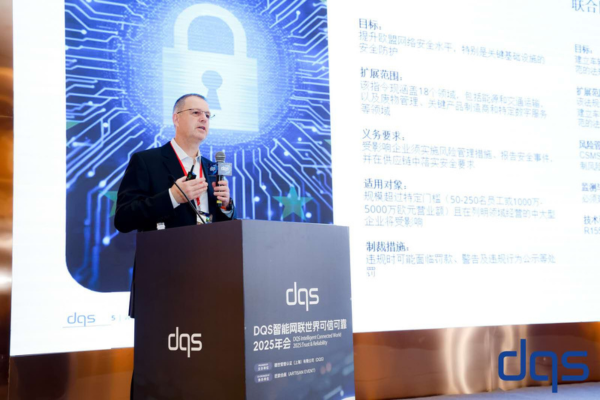
Mr. Ingo Unger, Global Director of IDS Strategic Development at DQS, opened the conference with a keynote on data governance and regulatory trends in the age of AI.
He provided an overview of ISO/PAS 8800 — a key emerging international standard for automotive AI safety — and examined the EU AI Act’s potential implications for the future of the mobility ecosystem.
Key takeaways included:
- AI safety is emerging as an independent discipline beyond traditional data compliance;
- Future regulations will place greater emphasis on proactive governance and system-level design;
- Organisations must develop long-term strategies for managing AI compliance effectively.
From Standards to Systems: Building Practical Compliance Frameworks
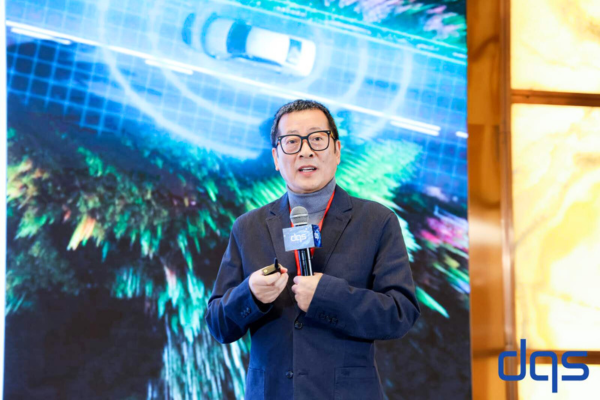
Amid increasingly complex and fragmented regulatory requirements, Mr. Lin Zuning, Chief Cybersecurity Expert at DQS Greater China, presented a methodology for embedding compliance into engineering processes.
Drawing upon standards such as UN R155, GB 44495, ISO 21434, and ASPICE, he proposed that:
- Cybersecurity considerations should be integrated throughout the development process rather than applied post-facto;
- Establishing a Cybersecurity Management System (CSMS) requires clear organisational roles, responsibility matrices, and supply chain coordination;
- Certification should reflect not only final compliance results, but also the maturity of process capability.
This systematic approach offers Chinese automotive enterprises a structured path to meet multi-level regulatory demands, highlighting DQS’s strength in combining local expertise with global standards.
Practical Applications: From Controller Design to Quality Systems
Afternoon sessions focused on implementation practices across the supply chain, covering topics such as:
- Engineering and verification mechanisms for domain controller information security;
- Integration of R&D quality management systems with functional safety and efficiency objectives.
By applying security-by-design principles, ASPICE-based safety frameworks, and end-to-end quality collaboration, DQS illustrated how certification supports enterprises in achieving compliance within real-world engineering and product development environments.
Certification as a Framework for Trust
Throughout the conference, DQS emphasised that certification is not merely a formality but a means of transforming enterprise capabilities into verifiable and transferable trust frameworks.
In an era defined by software-defined vehicles, AI-driven innovation, and accelerating global oversight, certification has become a strategic enabler for sustainable competitiveness in the intelligent mobility sector.
The event further demonstrated DQS’s ability to deliver not only insightful standard interpretation, but also practical implementation and localised support for enterprises operating in China.
Conclusion: Strengthening Global Competence through Compliance
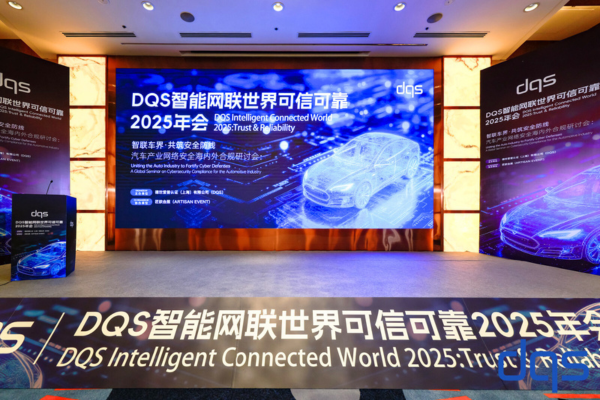
The Intelligent Connected World · Reliable and Trusted 2025 Conference served as both a platform for professional dialogue on regulations and a showcase of DQS’s evolving capabilities in China’s automotive certification landscape.
As a leading international certification body, DQS reaffirmed its commitment in three key areas:
- Global Insight Partner – Monitoring international regulatory developments and helping enterprises anticipate emerging requirements;
- Compliance Pathway Builder – Providing structured methodologies and tools spanning ISO/PAS 8800 to ISO 21434;
- Local Implementation Partner – Supporting rapid adaptation to China’s regulatory framework and strengthening internal compliance systems.
Looking forward, DQS will continue to collaborate with the Chinese automotive industry to enhance compliance, reliability, and efficiency across global operations — contributing to the advancement of safe and trustworthy intelligent mobility worldwide.