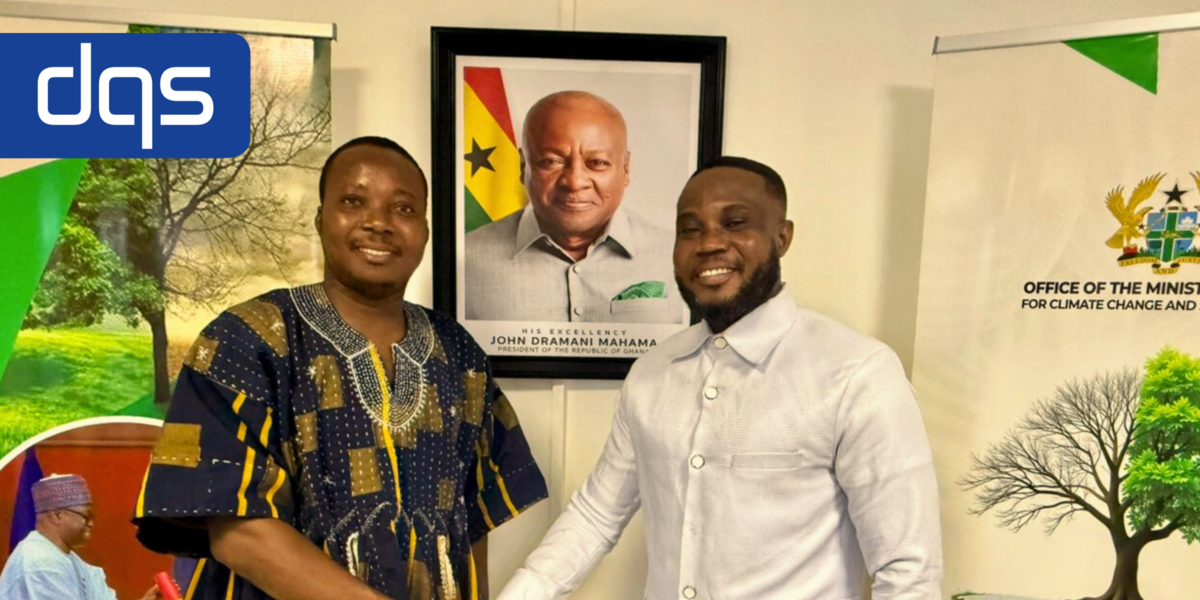
In a strategic move to strengthen Ghana’s climate governance and accelerate the implementation of sustainability goals, DQS has engaged with senior representatives of the Ghanaian government. During a high-level meeting in Accra, Cedric Dzelu, Technical Director at the Office of the Minister of State for Climate Change and Sustainability, and Gabriel Tekpetey, Head of Strategic Expansion – Africa at DQS’s South Africa office, discussed pathways to support Ghana’s climate agenda through credible standards, assurance frameworks, and institutional capacity building.
Loading...
The meeting opened with a shared commitment to Ghana’s national climate priorities, including the country’s Nationally Determined Contributions (NDCs), climate adaptation and resilience goals, and the long-term transition toward a low-carbon, sustainable economy. Both parties emphasized the importance of moving beyond policy formulation to measurable, auditable, and scalable execution across public institutions and high-impact industries.
Key focus areas included:
- Environmental, energy, and occupational health & safety management systems to support regulatory compliance and performance improvement;
- Greenhouse gas accounting and climate reporting frameworks to strengthen transparency and international credibility;
- ESG and sustainability reporting alignment with global best practices to support both public-sector accountability and private-sector market access.
Capacity Building and Institutional Strengthening
A strong emphasis was placed on capacity development within government institutions, regulators, and state-owned enterprises. The meeting explored opportunities for structured training and certification programs aimed at climate officers, environmental inspectors, and sustainability focal persons, with the objective of building local expertise and reducing long-term reliance on external consultants.
Digitalization, Data, and MRV Systems
Recognizing the growing importance of data-driven governance, the parties discussed digital and AI-enabled tools for climate and sustainability management. Proposed areas included Monitoring, Reporting and Verification (MRV) systems, ESG dashboards, and climate data platforms to support evidence-based decision-making, policy tracking, and compliance assurance.
Priority Sectors and Industry Engagement
The dialogue identified priority sectors where climate risks and regulatory demands are most pronounced, including mining, energy, manufacturing, construction, transport, and agribusiness. A collaborative public-private approach was discussed to support industry compliance while safeguarding competitiveness and alignment with international market requirements.
Partnership Models and Governance
Several collaboration pathways were explored, including:
- Technical partnership models for pilot projects and guideline development;
- Training and certification partnerships endorsed by the Ministry;
- Industry implementation partnerships supporting regulated entities.
Governance considerations—such as roles and responsibilities, data confidentiality, reporting structures, and performance indicators—were highlighted as critical to ensuring transparency, accountability, and long-term impact.
Climate Finance and International Alignment
The meeting also examined alignment with donor-funded and multilateral climate programs, climate finance readiness, and emerging carbon market mechanisms. Positioning Ghana to effectively execute funded projects through credible technical and assurance partners was identified as a strategic priority.
Way Forward
The engagement concluded with agreement on clear next steps, including the preparation of a concept note outlining scope, timelines, and responsibilities, and the identification of pilot initiatives with potential for national scale-up. Both parties reaffirmed their commitment to a collaborative model that bridges policy, practice, and performance. This strategic meeting represents a significant step toward strengthening Ghana’s climate governance ecosystem and underscores the role of credible international partners, such as DQS, in supporting sustainable development outcomes across Africa.