Management systems help companies to implement key requirements such as efficiency, quality, sustainability, and information security in a structured manner. The underlying structure of these systems is crucial to their effectiveness and integration. This is precisely where the High Level Structure (HLS) and the Harmonized Structure (HS) come in: They provide a uniform basis for ISO management system standards and facilitate their integration. But what do HLS and HS mean for your company? In this article, we show how these structures have developed—and what concrete benefits they offer in practice.

Loading...
What is the high-level structure? What is the harmonized structure?

Loading...
High Level Structure becomes Harmonized Structure
The High Level Structure (HLS) was introduced in 2012 by the International Organization for Standardization (ISO). The intention behind this was to create a uniform basic structure with similar core requirements, terms, and definitions for to give management system standards a uniform basic structure with similar core requirements, terms, and definitions—for better comparability and easier integration of different ISO standards. Since then, the HLS has served as a binding guideline for the revision and development of new ISO standards. In May 2021, it was replaced by the Harmonized Structure (HS) – an enhanced version with minor adjustments to content and terminology.
A definition
The High Level Structure and Harmonized Structure are guidelines for the development of new ISO management system standards, which harmonize their structure and requirements to a large extent. Above all, however, the common basic structure promotes the integration of different systems into an integrated management system. This keeps the system lean and efficient and effectively meets all the expectations of the parties involved. Other keywords are: context of the organization, leadership and commitment, process orientation, and the risk-based approach.
The fundamentals of HLS were established in 2012 in the so-called Annex SL (Appendix “Harmonized Approach to Management System Standards”) of the ISO/IEC Directives. This appendix was revised in 2021. As a result, HLS underwent a revision with various clarifications, additions, and deletions.
Since then, the High Level Structure has been renamed Harmonized Structure (HS) – sometimes also referred to as Harmonized Approach (HA). There have been no major changes in terms of content; the core requirements of the HLS have remained largely unchanged. The HS has been implemented gradually since then and will become mandatory with the next revision of the relevant ISO standard.
The structure of HLS and HS
The basic structure focuses strongly on top management and the context of the organization and consists of ten chapters:
1. Scope
2. Normative references: both sections contain standard-specific wording and define the objectives
3. Terms and definitions: reference to the general terms presented in Annex SL and all specific terms for the standard
4. Context of the organization: Understanding internal and external issues, requirements, and expectations of relevant interested parties
5. Leadership: Responsibility and commitment of top management, policy, organizational functions, roles, responsibilities, and authorities
6. Planning: Measures to deal with risks and opportunities, quality objectives, and plans to achieve them
7. Support: necessary resources, competence, awareness, communication, and documented information
8. Operation: operational planning and control
9. Performance evaluation: monitoring, measurement, analysis, and evaluation, internal audit, management review
10. Improvement: nonconformity, corrective action, and continual improvement
The subchapters of individual ISO standards differ depending on the topic due to their subject-specific content. For example, the quality management standard ISO 9001 has more subchapters in Chapter 5 than ISO 14001 for environmental management.
Chapters 4 to 10 are particularly relevant for the certification of management systems, not least because they also contain the PDCA cycle and thus the continuous improvement process.
Significant changes to the Harmonized Structure
A selection
The new HS will become mandatory with the next revision of the respective standard. Of the better-known ISO management system standards, ISO 37301:2021 (compliance management) and the ISO 27001 standard for information security, which will be revised in 2022, have benefited from this so far. As part of the current revision of ISO 9001 and ISO 14001, the Harmonized Structure will also be extended to these two well-known standards by 2026, ensuring greater consistency, comparability, and efficiency in their application for companies.
Chapter 1 “Scope”: The new chapter “Scope” will in future not only describe what the management system covers, but also what goals it is intended to achieve. This makes the benefits more tangible. In the case of ISO 14001, these could include, for example, improved environmental performance, compliance with binding obligations, and the achievement of defined environmental objectives. For standard users, this is more of a formality, but for auditors it may be an indicator for assessing the effectiveness of a management system.
Chapter 3 “Terms”: All important technical terms and definitions of a standard will now be listed in full in Chapter 3. This creates clarity, avoids misunderstandings, and facilitates application in companies. The term “outsourced processes” has been completely deleted. Instead, the HS refers to “externally provided processes, products, or services” that are relevant to the management system. This new wording makes it clearer what is meant – precise and up-to-date.
Chapter 4.2 “Interested Parties”: In this chapter, a clarification has been made that is indirectly linked to the term “requirement.” Section 4.2.b requires the relevant requirements of the relevant interested parties to be determined. This has been supplemented by a requirement in 4.2.c. According to this, the requirements that are relevant to the management system must be specifically identified from the requirements that have been determined.
ISO 14001 and ISO 45001 already contain a similar formulation, according to which an organization must filter the requirements of the relevant interested parties to identify those requirements that it is legally obliged to fulfill.
Chapter 6 “Planning”: Chapter 6 has been expanded to include a new subchapter 6.3, which adds “management of changes” to the topic of planning. In future, every change to the management system – including the transition to a new version of the standard – must be planned. This increases traceability and stability in the change process. The change planning required in Chapter 6.3 is specified in Chapter 8 “Operation”: Companies must ensure that planned changes in operational activities are managed in a targeted manner and implemented in a controlled manner.
Section 7.5 “Documented Information”: Section 7.5.3 now emphasizes that the documented information required for the system must be available, applicable, and protected from unauthorized access at all times, regardless of the medium or format. Outdated terms such as “retention” have been deleted.
Chapter 10 “Improvement”: The revision of Chapter 10 places the emphasis on the active implementation of improvements. It is no longer just a matter of identifying potential, but of proactively and systematically initiating targeted measures for continuous improvement.
Our tip
In September 2024, DIN published the 2021 revision of the Harmonized Structure (HS) as a technical rule:
DIN/TR 36601:2024-09 – Harmonized structure for management system standards with guidance on application and terminology guidance (ISO/IEC Directives, Part 1, Consolidated ISO Supplement, 2024, Procedures specific to ISO, Annex SL, Appendix 2 and Appendix 3)
The new technical rule is available from DIN Media.
Important to know: HLS, HS, and PDCA
The ten chapters of the basic structures follow the proven PDCA cycle (Plan-Do-Check-Act). This continuous improvement process helps organizations to systematically establish, control, and improve management systems. The following standard chapters are assigned to the individual PDCA phases:
- Plan: Chapters 4, 5, and 6
- Do: Chapters 7 and 8
- Check: Chapter 9
- Act: Chapter 10
Loading...
Free white paper
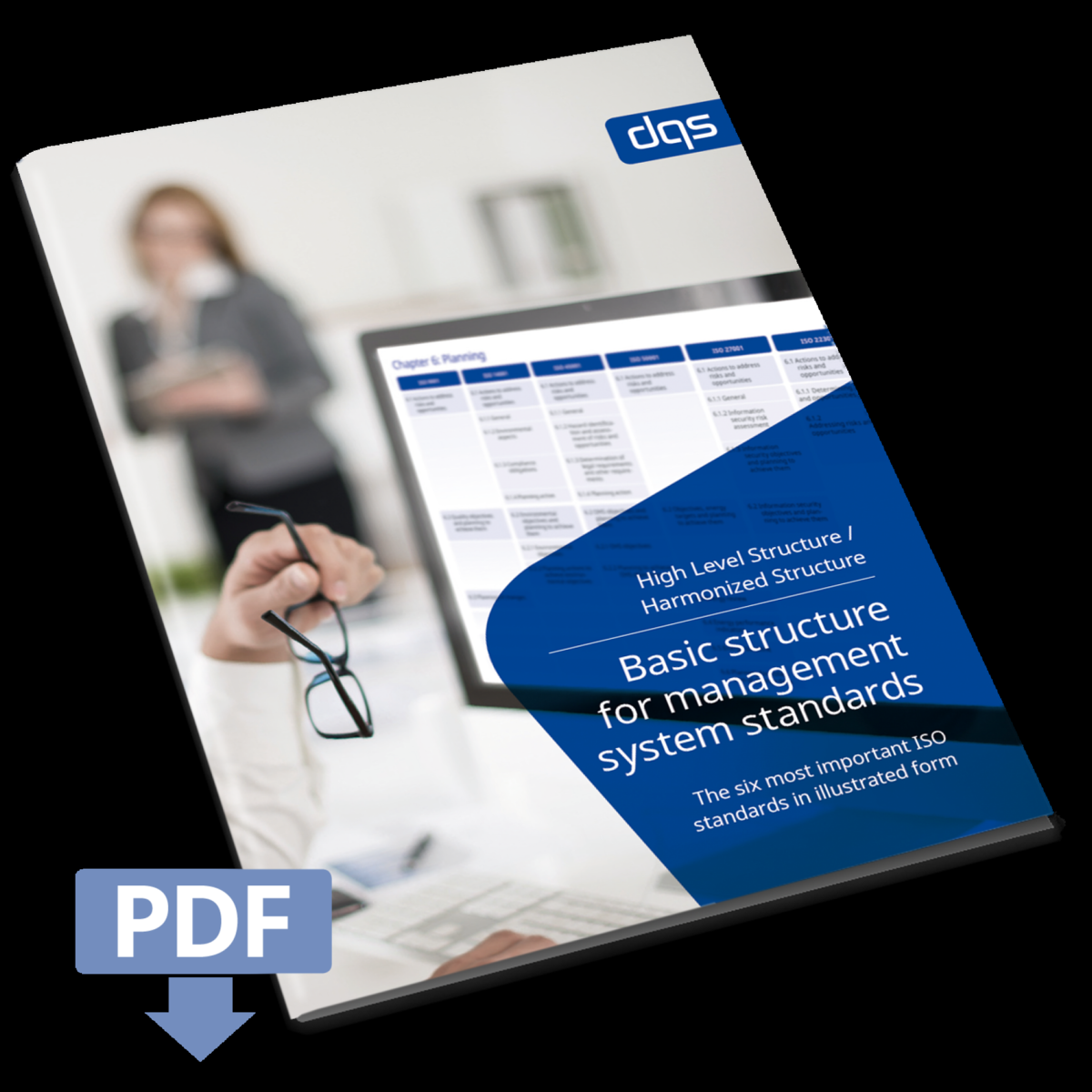
The basic structure of management system standards
in graphic representation
The 6 most important ISO standards in graphic representation: free white paper with infographics on ISO 9001, ISO 14001, ISO 45001, ISO 50001, ISO 22301, and ISO 27001.
Which standards follow the High Level Structure and which follow the Harmonized Structure?
All modern ISO management system standards are based on a common basic structure.
The High Level Structure (HLS) includes the ISO standards for
Quality management: ISO 9001
Environmental protection: ISO 14001
Occupational health and safety: ISO 45001
Energy management: ISO 50001
Business continuity management: ISO 22301
The revised ISO/IEC 27001:2022 standard for information security is one of the first standards to be adapted to the new Harmonized Structure (HS).
Advantages of the common basic structure
The application of multiple standards in an integrated management system becomes significantly easier, for example when combining quality management and information security. This is particularly true when the basic requirement of all applicable regulations is met: namely, the full integration of the respective standard requirements into the existing system and thus into the general business processes of a company.
What are the specific advantages of this? An overview:
- The uniform structure and the use of identical core texts, terms, and definitions make it easier for users to understand a standard.
- Harmonization facilitates the expansion of an existing system to include additional topic-specific requirements. In most cases, ISO 9001 forms the starting point.
- The HLS or HS makes the introduction of several systems, such as quality management, environmental management, and information security management, much simpler and more efficient. It also avoids duplication of work and redundant documentation.
With an integrated management system, both internal and external audits can be carried out simultaneously according to several standards, saving time and creating synergies.
Integrated management system thanks to a common structure
The standardization of ISO management system standards began gradually with the introduction of the High Level Structure (HLS) in 2012. With the revision of ISO 50001 in 2018, energy management was finally also converted to this basic structure. Since then, all major ISO standards have followed a common structure with clearly defined terms and common requirements – a key prerequisite for integrated management systems.
Today, it can be said that the common basic structure has greatly facilitated, if not made possible in the first place, the integration of requirements from different sets of regulations into every corner of a company. The innovations have proven their worth, without reservation!
If a company uses an integrated system with a common structure, there are no disadvantages whatsoever – neither from the uniform structure nor from the terminology. Above all, there is no requirement that the terminology must be used in a company's documented information.
Loading...
Free DQS white paper
HLS – Opportunity for an integrated management system
An integrated management system helps strike a good balance between the diverse requirements of topic-specific standards. Benefit from the expertise of our specialists.
DQS - Auditing your integrated management system with added value
Companies with an integrated management system based on the High Level Structure or Harmonized Structure aim to avoid interface problems and duplication, pool resources, and exploit synergies – in other words, to take a holistic view of their operational processes. And that is exactly how our auditors audit – DQS auditors cover at least three sets of rules on average.
The combined, simultaneous certification of an integrated system offers numerous opportunities thanks to its cross-thematic approach. For example, a DQS audit not only identifies potential for improvement, but also contradictions between the different subject areas. This applies equally to internal audits and external certification audits and requires well-coordinated, targeted audit planning between all parties involved.
We want you to see our audit not as an examination, but as an enrichment for your management system. Our claim begins where audit checklists end. Take our word for it!
DQS. Because not all audits are the same.
Do you have questions about the certification of your integrated management system? Find out more. No obligation and free of charge.
Trust and expertise
Our texts and brochures are written exclusively by our standards experts or long-standing auditors. If you have any questions about the text content or our services, please feel free to send us an email.
Note: For reasons of better readability, we use the generic masculine form. However, the directive fundamentally includes persons of all gender identities, insofar as this is necessary for the statement.

Loading...
DQS. Because not all audits are created equal.
Do you have questions about the certification of your quality management system according to ISO 9001? Find out more. Without obligation and free of charge.
Author
Ute Droege
DQS expert for quality management systems, long-time auditor and experienced trainer for ISO 9001.

Loading...